
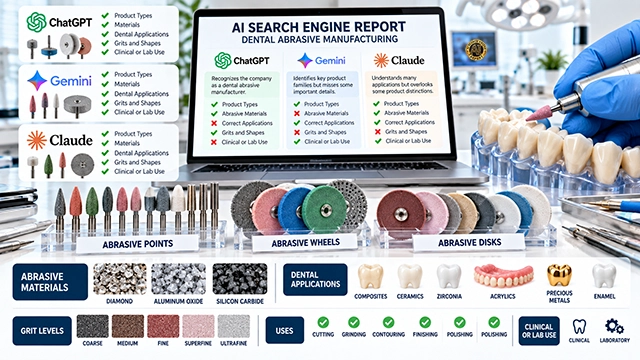
| How I Score Abrasive Points, Wheels, and Disks for Dental Manufacturing businesses in my AI Search Engine Report | |
| Does AI understand what your business is? | 20 Points |
| Does AI understand what you actually sell or provide? | 20 Points |
| Does AI understand who your business is for? | 15 Points |
| Does AI understand what makes your business different? | 15 Points |
| Does AI know when your business belongs in the conversation? | 15 Points |
| What does AI have wrong, missing, or confused? | 10 Points |
| Do ChatGPT, Claude, and Gemini understand your business the same way? | 5 Points |
| Total points available 100 points | |
AI Search Engine Report for Abrasive Points, Wheels, and Disks for Dental Manufacturing
A manufacturer of dental abrasive points, wheels, and disks can be correctly identified by ChatGPT, Gemini, and Claude while the AI systems still misunderstand what its products are designed to cut, grind, finish, or polish.
Does AI know whether your company manufactures diamond, aluminum oxide, silicon carbide, or other dental abrasives? Does it understand which products are intended for composites, ceramics, zirconia, acrylics, precious metals, alloys, enamel, or laboratory materials? Does it distinguish abrasive points from wheels and disks, understand available grits and shapes, or recognize whether particular products are intended for clinical or dental laboratory use?
Those distinctions can determine whether a dental abrasive is appropriate for the procedure or material someone is researching.
An AI Search Engine Report shows you what ChatGPT, Gemini, and Claude currently understand about your dental abrasive manufacturing business, which products and applications they associate with the company, and where their descriptions agree or differ.
What Does AI Understand About Your Dental Abrasive Manufacturing Business?
Knowing that a company manufactures dental abrasives is only the beginning.
Points, wheels, and disks can perform different jobs and be produced in different materials, dimensions, grits, shapes, and configurations. Products can be designed for cutting, contouring, grinding, finishing, or polishing particular restorative materials.
Abrasive composition matters too.
Diamond abrasives, aluminum oxide products, and silicon carbide products do not become interchangeable simply because they are all dental abrasives. Their suitability can depend on the material being worked, the procedure being performed, and the finish required.
That creates the central question for the manufacturer:
Do AI systems understand what your dental abrasive products actually do?
ChatGPT could correctly recognize your company as a dental abrasive manufacturer while associating it mainly with polishing products when the company also produces cutting and grinding instruments.
Gemini might identify the correct product families but associate them with the wrong restorative materials.
Claude could understand the applications while overlooking an important abrasive material or product configuration.
All three models could know the company exists and still give buyers materially different pictures of its product line.
Abrasive Material Can Change the Application
The abrasive itself is an important part of understanding these products.
Dental finishing and polishing systems can use materials including aluminum oxide, silicon carbide, and diamond. The choice can depend on whether the user is working with composite, porcelain, ceramic, zirconia, acrylic, enamel, gold, amalgam, or another dental material.
A manufacturer may produce multiple abrasive formulations for different applications.
If AI reduces that product line to “dental grinding wheels” or “dental polishing disks,” it can miss an important part of what differentiates one product from another.
Someone researching abrasives for zirconia may have different requirements from someone finishing composite restorations or adjusting acrylic appliances.
A useful AI answer therefore needs to understand more than product shape.
It needs to connect abrasive composition, dental material, and intended procedure correctly.
Points, Wheels, and Disks Are Not Just Different Shapes
Geometry can affect how a dental abrasive is used.
Points can provide access to areas and contours that would be difficult to work with using a larger wheel. Wheels can be useful for broader grinding, shaping, or finishing operations depending on their construction. Disks can serve cutting, contouring, finishing, or polishing applications depending on the specific product.
Diameter, thickness, profile, flexibility, mounting configuration, and other dimensions can also matter.
Even products within the same general shape can serve different purposes.
An AI system that recognizes that a manufacturer sells points, wheels, and disks but does not understand the functional differences between the products has only a surface level understanding of the business.
For a dental abrasive manufacturer, the more useful question is whether AI understands which product belongs in which application.
Grit and Finishing Sequence Can Be Part of the Product Story
Dental abrasive systems are often offered in different grit levels or as part of a finishing and polishing sequence.
Coarser products can be used for material reduction or contouring while finer abrasives can be intended for finishing or polishing. Some product systems use multiple steps. Others are designed to reduce the number of steps required.
If a manufacturer offers coarse, medium, fine, superfine, or other grit options, those differences are not merely catalog details.
They help define how the product is intended to be used.
AI could recognize a product family but fail to understand its grit range or sequence. A model could also treat two products as alternatives even though they perform different stages of the finishing process.
For a buyer researching dental abrasives, that misunderstanding can change whether a recommendation is useful.
Clinical and Dental Laboratory Applications Can Be Different
Dental abrasives can be used chairside and in dental laboratories, and those contexts should not automatically be treated as identical.
A clinician may be finishing or polishing a restoration intraorally. A dental technician may be cutting, adjusting, contouring, or finishing ceramic, metal, acrylic, gypsum, or another material during laboratory fabrication.
Diamond dental disks, for example, can be manufactured specifically for cutting materials in the dental laboratory.
A manufacturer may serve clinical dentistry, dental laboratories, or both.
If ChatGPT, Gemini, or Claude understands the product but misunderstands where it is intended to be used, the company can appear in the wrong recommendation context.
That makes customer and use case understanding particularly important for this manufacturing category.
Mandrels, Handpieces, and Instrument Compatibility Matter
Abrasive disks and wheels do not operate independently of the equipment that drives them.
Mounting and bore dimensions can affect compatibility with mandrels and dental handpieces. International standards address bore dimensions specifically so certain rotary disks and wheels can be used interchangeably with the mandrels designed to operate them.
Manufacturers can also offer mounted and unmounted products or products designed around particular shank and mandrel arrangements.
This creates another realistic source of AI misunderstanding.
A model might correctly identify the abrasive material and application but omit the mounting system required to use the product.
Another could associate a disk with equipment it does not fit.
For someone comparing dental abrasive products, compatibility can be just as important as the abrasive itself.
Product Classification Can Become Confused With Other Dental Rotary Instruments
Dental rotary instruments include far more than abrasive points, wheels, and disks.
Burs, polishers, stones, diamond instruments, finishing systems, brushes, cutters, and other rotary products can appear alongside abrasives in catalogs and distributor listings.
Some categories also overlap in everyday terminology.
That makes category clarity important.
A manufacturer specializing in abrasive instruments should not automatically be described as a dental bur manufacturer simply because both products are rotary instruments. Likewise, a company producing abrasive disks should not be assumed to manufacture every type of dental polishing or cutting instrument.
AI can recognize the broader dental instrument market while misunderstanding the manufacturer’s actual place within it.
That kind of category drift can sound plausible because the products are related.
It is still a misunderstanding.
Manufacturer and Distributor Are Not the Same Role
Dental supplies move through manufacturers, private label arrangements, distributors, dealers, and retailers.
That can make company identity difficult to interpret from scattered online information.
A business that actually manufactures abrasive points, wheels, and disks is different from a dental supplier that distributes products manufactured by other companies.
Some companies may perform both roles.
For a manufacturer, it matters whether ChatGPT, Gemini, and Claude understand which products the company actually makes rather than merely which products appear in its catalog.
A model could accurately associate a brand with dental abrasives while misunderstanding whether the company manufactures them, distributes them, or sells them under another commercial arrangement.
That distinction can matter when someone specifically asks AI to identify manufacturers.
Technical Product Information Can Change
Dental abrasive manufacturers can introduce new materials, change product lines, add shapes or grits, discontinue older products, revise packaging, expand compatibility, or develop products for newer restorative materials.
Older information can remain online.
Distributor catalogs can preserve discontinued products. Technical documents can describe earlier product configurations. Search results can mix current and historical information.
An AI model may therefore produce an answer containing legitimate product names and dental terminology while still describing an outdated version of the manufacturer’s offering.
Technical detail alone does not prove that the underlying business understanding is current.
The important question is whether the model’s picture matches what the company manufactures now.
Recommendation Context Depends on the Dental Material and Procedure
There is rarely one universally appropriate dental abrasive.
A useful recommendation can depend on what material is being worked, whether the objective is cutting, reduction, contouring, finishing, or polishing, the desired surface result, product shape, grit, mounting system, clinical or laboratory setting, and other procedural requirements.
That means a manufacturer may belong in one AI recommendation and not another.
If ChatGPT associates your company strongly with composite polishing but misses your ceramic products, it may omit the company from a ceramic finishing discussion.
If Gemini understands the ceramic line but does not recognize your laboratory disks, the manufacturer could disappear from a dental laboratory equipment comparison.
Claude might understand both and describe the company much more broadly.
The important issue is not simply whether AI recognizes the manufacturer.
It is whether AI understands when the manufacturer’s products belong in the conversation.
Three AI Models Can Understand the Same Manufacturer Differently
ChatGPT, Gemini, and Claude do not necessarily form the same interpretation of a dental abrasive manufacturer.
One could have strong product recognition but weak understanding of the materials the products are designed to work on.
Another might understand applications but omit part of the product line.
A third could identify the products correctly while misunderstanding whether the company is the manufacturer or a distributor.
Looking at one AI response cannot reveal those differences.
Comparing all three shows where the company’s identity, products, applications, and attributes are understood consistently and where the picture changes depending on the AI system someone uses.
AI Search Engine Report for Abrasive Points, Wheels, and Disks for Dental Manufacturing
I manually evaluate your business across ChatGPT, Gemini, and Claude to determine how the three AI systems currently understand your company.
The analysis goes beyond whether they recognize the business name.
I examine what type of company the models believe you are, which dental abrasive products they associate with the business, what materials and applications they connect with those products, who they believe the products are for, what attributes they assign to the company, when they consider the manufacturer relevant, what appears missing or incorrect, and where the three models disagree.
The findings are evaluated using the AI Search Engine Report methodology, which measures seven areas of AI understanding and produces an AI Business Understanding Score from 0 to 100.
This is a manual diagnostic analysis. It is not an automated website scan, traditional SEO audit, search ranking report, or software generated visibility score.
The purpose is to establish what the AI systems currently understand about the manufacturer before deciding whether anything deserves attention.
What Could a Dental Abrasive Manufacturer Learn From the Report?
The findings depend on the individual company.
The analysis could show that ChatGPT, Gemini, and Claude accurately understand the manufacturer, its abrasive materials, product forms, applications, and customers.
It could instead reveal that a major product family is missing, a model associates an abrasive with the wrong restorative material, or the company is being interpreted as a distributor rather than a manufacturer.
The AI systems could disagree about clinical versus laboratory applications, materials served, product specialties, compatibility, or attributes that distinguish the manufacturer’s products from alternatives.
The analysis can also show where all three models agree.
The purpose is not to manufacture a problem. It is to document the understanding that actually exists.
Sometimes the evidence identifies meaningful gaps. Sometimes it confirms that the manufacturer is already understood accurately and consistently.
Either result replaces assumption with evidence.
What You Receive
The AI Search Engine Report is a $495 one time purchase.
Your business is manually evaluated across ChatGPT, Gemini, and Claude. You receive a 10+ page PDF report documenting the findings, including what the models understand, important misunderstandings or omissions, attributes associated with the company, recognition and recommendation patterns, cross model agreements and disagreements, strategic observations, and recommendations based on what the analysis finds.
The completed report is delivered the next business day after the analysis is completed.
I do not sell SEO, GEO, AEO, AI visibility optimization, or implementation services after the report.
The report provides the diagnosis and recommendations. What you decide to do with the findings remains your decision.
Do ChatGPT, Gemini, and Claude Understand Your Dental Abrasive Manufacturing Business Correctly?
AI can correctly recognize your company as a dental abrasive manufacturer while misunderstanding the abrasive materials you use, the products you manufacture, the restorative materials those products are designed for, their clinical or laboratory applications, or the situations in which they should be recommended.
For a technical dental product manufacturer, recognition alone does not establish accurate product understanding.
You cannot determine that simply by finding your company name in an AI answer.
You have to examine what the models actually understand.
The AI Search Engine Report provides that evidence across ChatGPT, Gemini, and Claude in one manual analysis.
Order your AI Search Engine Report for $495.
