
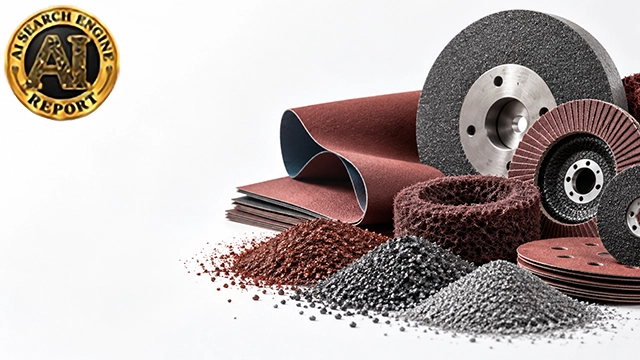
| How I Score Abrasive Points, Wheels, and Disks for Abrasive Products Manufacturing businesses in my AI Search Engine Report | |
| Does AI understand what your business is? | 20 Points |
| Does AI understand what you actually sell or provide? | 20 Points |
| Does AI understand who your business is for? | 15 Points |
| Does AI understand what makes your business different? | 15 Points |
| Does AI know when your business belongs in the conversation? | 15 Points |
| What does AI have wrong, missing, or confused? | 10 Points |
| Do ChatGPT, Claude, and Gemini understand your business the same way? | 5 Points |
| Total points available 100 points | |
AI Search Engine Report for Abrasive Products Manufacturing
An abrasive products manufacturer can be correctly identified by ChatGPT, Gemini, and Claude while the AI systems still have a poor understanding of what the company actually manufactures.
Does AI know whether your company produces bonded abrasives, coated abrasives, nonwoven products, superabrasives, abrasive grain, or several of these categories? Does it understand whether your products are made for grinding, cutting, sanding, deburring, blending, finishing, polishing, or surface preparation? Does it associate the correct abrasive materials, bond systems, backing materials, grit ranges, product forms, and industrial applications with your company?
Those distinctions are fundamental to abrasive products manufacturing.
An AI Search Engine Report shows you what ChatGPT, Gemini, and Claude currently understand about your abrasive products manufacturing business, what products and applications they associate with your company, and where their descriptions agree, differ, or leave important information out.
What Does AI Understand About Your Abrasive Products Manufacturing Business?
Knowing that a company manufactures abrasives is only the beginning.
The abrasive products industry includes distinctly different types of manufacturing. Abrasive grain can become an input for other abrasive products. Bonded abrasives include products such as grinding wheels, cutting wheels, stones, and other formed products. Coated abrasives apply abrasive grain to flexible backing materials and can become belts, discs, sheets, rolls, and other finished products. Nonwoven products add another category, while diamond and cubic boron nitride products can serve specialized grinding and finishing applications.
That creates an immediate question for a manufacturer:
Does AI understand which part of the abrasive products industry your company actually occupies?
ChatGPT could correctly recognize your company as an abrasive manufacturer but associate it primarily with grinding wheels when coated abrasives make up an important part of your product line.
Gemini might identify your belts and discs while overlooking your bonded products.
Claude could understand the product categories but associate them with applications or materials your products were not designed to handle.
Each model could contain accurate information while presenting a substantially different picture of the same manufacturer.
Bonded, Coated, and Nonwoven Abrasives Are Different Product Categories
Calling all of these products “abrasives” can hide the distinctions a buyer actually needs.
Bonded abrasives hold abrasive grains within a bond system and include many grinding and cutting products. Coated abrasives attach grain to flexible backing materials such as paper, cloth, film, or other substrates. Nonwoven abrasives use a fibrous structure containing abrasive grain and can be used for applications such as cleaning, deburring, blending, and surface finishing.
A manufacturer may specialize in one category or operate across several.
AI needs to understand that difference.
If a company manufactures coated abrasive belts for metalworking, woodworking, and other industrial applications, describing the business primarily as a grinding wheel manufacturer is not a minor wording problem. It misrepresents the product line.
The opposite can happen as well.
A manufacturer known for bonded grinding and cutoff wheels should not automatically be treated as a source for every type of sanding belt, coated disc, or nonwoven finishing product simply because all of them belong to the broader abrasives market.
This is one reason category understanding matters when people use AI to identify and compare manufacturers.
Abrasive Grain Is Only One Part of Product Understanding
The abrasive material itself can substantially change what a product is designed to do.
Common manufactured abrasive materials include aluminum oxide and silicon carbide. Other products can use ceramic alumina, alumina zirconia, diamond, cubic boron nitride, and additional abrasive materials.
Those names are not interchangeable catalog terminology.
Abrasive characteristics such as hardness, toughness, grain shape, particle size, fracture behavior, purity, and thermal stability can influence how a product performs. The workpiece material and intended operation also affect which abrasive belongs in a particular application.
A company can therefore have excellent AI recognition at the brand level and poor understanding at the product level.
Suppose your company manufactures multiple abrasive families using different grains for different materials and applications.
An AI system might associate the company strongly with aluminum oxide while missing its silicon carbide products.
Another might recognize conventional abrasives but overlook its diamond or CBN line.
A third could list the correct abrasive materials but fail to connect them with the applications for which your products were actually engineered.
The company name is correct. The product understanding is not.
Bond, Grade, Grit, and Structure Can Change What a Grinding Product Does
Two grinding wheels that look similar can have very different specifications and intended uses.
The abrasive grain is only part of a bonded abrasive product. The bond holds the grain within the wheel. Grit size affects cutting behavior and finish. Wheel grade relates to the holding power of the bond. Structure describes the spacing of abrasive grains and the porosity within the wheel.
Bond systems themselves can differ, including vitrified, resin, rubber, metal, and other formulations depending on the product and application.
These characteristics can affect stock removal, wheel life, form holding, finish, coolant access, cutting behavior, and suitability for different materials and grinding conditions.
That level of distinction matters when AI moves beyond describing a manufacturer and starts answering application specific questions.
A model could know that your company makes grinding wheels without understanding the specifications that make different wheel families appropriate for different operations.
For a technical abrasive manufacturer, that is incomplete business understanding.
Coated Abrasives Have Their Own Product Variables
Coated abrasive manufacturing creates a different set of distinctions.
The abrasive grain is applied to a backing, and the combination of grain, adhesive system, backing material, grit, product form, and construction helps determine how the finished abrasive behaves.
A manufacturer might produce belts, fiber discs, flap discs, sheets, rolls, quick change discs, film backed products, or other coated abrasive forms.
Even within a single form such as an abrasive belt, products can be engineered for different machines, workpiece materials, pressures, finishing requirements, and industries.
AI can flatten those distinctions.
A model might correctly state that your company manufactures abrasive belts but fail to understand whether the products are designed primarily for metalworking, woodworking, composites, stainless steel, specialty alloys, or multiple markets.
Another might associate your brand with sanding discs while missing an important belt or specialty coated product line.
The useful question is not simply whether AI knows that you sell coated abrasives.
It is whether AI understands what those abrasives are designed to do.
The Workpiece Material Changes the Recommendation
Abrasive selection depends heavily on what is being cut, ground, sanded, polished, or finished.
Steel, stainless steel, aluminum, cast iron, carbide, ceramics, glass, composites, wood, plastics, and other materials can present very different abrasive requirements.
The operation matters too.
Rapid stock removal is not the same objective as achieving a particular surface finish. Cutting is different from deburring. Precision grinding is different from general surface preparation.
This creates an important recommendation issue.
Someone may ask ChatGPT for an abrasive manufacturer serving precision grinding of hardened steel.
Another buyer may ask Gemini about abrasive belts for stainless fabrication.
Someone else could ask Claude about products for finishing composites or grinding carbide.
Your company may belong in one, several, or none of those conversations depending on what you actually manufacture.
If an AI system does not understand the connection between your products, abrasive materials, workpiece materials, and applications, it may not understand when your company belongs in the recommendation at all.
Standard Products and Engineered Abrasive Solutions Can Tell Different Stories
Not every abrasive manufacturer competes in the same way.
Some manufacturers offer broad catalogs of standard products. Others develop abrasive specifications around particular customer applications, materials, machines, tolerances, production requirements, or finishing objectives. A company can do both.
That distinction can be important to how the business should be understood.
If your company engineers bond formulations, develops custom wheel specifications, converts coated products into specialized configurations, or works directly with manufacturers to solve grinding and finishing problems, a generic description such as “abrasives supplier” can omit a major part of the business.
AI may know what you sell without understanding how you compete.
That matters because buyers do not always search for a product number.
They may be looking for a manufacturer capable of solving a specific application problem.
Manufacturer, Converter, Distributor, and Supplier Are Not the Same Thing
The abrasives supply chain can make company identity especially easy to misunderstand.
A company may manufacture abrasive grain. Another may manufacture finished bonded or coated products. A converter may take jumbo rolls or other materials and produce finished belts, discs, sheets, or specialized shapes. A distributor may sell abrasive products manufactured by several companies.
Some businesses perform more than one of these roles.
AI should not assume that they are interchangeable.
If your company actually manufactures abrasive products, it matters whether ChatGPT, Gemini, and Claude understand which products you make rather than simply which products appear on your website or in a catalog.
A manufacturer interpreted primarily as a distributor can disappear when someone specifically asks AI for manufacturers.
A distributor interpreted as a manufacturer creates the opposite problem.
The terminology may sound close. The businesses are not the same.
Product Breadth Can Make an Abrasive Manufacturer Harder to Understand
A broad abrasive product portfolio creates another problem.
A manufacturer may serve metal fabrication, automotive manufacturing, aerospace, cutting tool production, woodworking, construction, foundries, bearing manufacturing, medical manufacturing, energy, general industrial maintenance, and other markets.
The same company might offer cutting wheels, grinding wheels, flap discs, belts, sheets, nonwoven products, specialty finishing products, or superabrasives.
That breadth can produce uneven AI understanding.
ChatGPT might strongly associate the company with metal fabrication because that information appears prominently across the web.
Gemini might have broader knowledge of its industrial product lines.
Claude might identify a specialty division or product family that the other two barely mention.
None of those differences can be discovered by checking one AI system once.
You have to compare what the models actually understand.
Current Product Information Matters
Abrasive manufacturers introduce new grain technologies, formulations, bond systems, product families, sizes, shapes, and application specific products. Older products can be discontinued or replaced.
At the same time, older catalogs, distributor listings, technical documents, product pages, and third party references can remain online.
That creates an opportunity for interpretation drift.
An AI model might correctly identify a product name but describe an older specification.
Another might associate your company with a product family you no longer manufacture.
A third could overlook a newer product line because older information has a stronger presence in the material it associates with the business.
Technical language can make these answers look convincing.
That does not necessarily make them current.
For an abrasive products manufacturer, the question is whether AI’s picture of the business matches what the company manufactures today.
Related Abrasive Businesses Can Create Category Confusion
Abrasive manufacturing sits next to several related industries and product categories.
For example, abrasive points, wheels, and disks for dental manufacturing is a specialized abrasive manufacturing category where product material, shape, grit, restorative material, and clinical or laboratory application can determine whether a product is appropriate.
Abrasion testing machines manufacturing is entirely different. Those companies manufacture equipment used to measure abrasion and wear rather than the abrasive products themselves.
The language is related enough that an AI system needs to understand the underlying business category instead of relying on word associations.
An abrasive products manufacturer should be understood for the abrasive products it actually makes.
Three AI Models Can Understand the Same Manufacturer Differently
ChatGPT, Gemini, and Claude do not necessarily form the same picture of an abrasive products manufacturer.
One model might understand your bonded abrasive line well but have limited recognition of your coated products.
Another might identify the full product range but misunderstand which industries or materials those products serve.
A third might correctly understand your applications but describe the company as a distributor rather than a manufacturer.
That disagreement is itself useful information.
Looking at only one AI response cannot show whether the understanding is consistent across the three systems.
Cross model comparison can.
AI Search Engine Report for Abrasive Products Manufacturing
I manually evaluate your business across ChatGPT, Gemini, and Claude to determine how the three AI systems currently understand your company.
The analysis goes beyond whether they recognize your name.
I examine what type of business the models believe you are, which abrasive products they associate with the company, what applications and customers they connect with those products, what attributes they associate with your business, when they consider your company relevant to a recommendation, what appears incorrect or missing, and where the three models disagree.
The findings are evaluated using my AI Search Engine Report methodology, which measures seven areas of AI understanding and produces an AI Business Understanding Score from 0 to 100.
This is a manual diagnostic analysis. It is not an automated website scan, traditional SEO audit, search ranking report, or software generated visibility score.
The purpose is to determine what the AI systems currently understand before deciding whether anything deserves attention.
What Could an Abrasive Products Manufacturer Learn From the Report?
The findings depend on the individual company.
The analysis could show that ChatGPT, Gemini, and Claude accurately understand the manufacturer, its product categories, abrasive materials, applications, customers, and distinguishing attributes.
It could instead reveal that an important product family is missing, conventional and superabrasive products are being confused, or the company is interpreted primarily as a distributor rather than a manufacturer.
The models could disagree about whether the company manufactures bonded, coated, or nonwoven products. They could associate different industries with the business, disagree about important product applications, or give different pictures of what makes the manufacturer’s products distinctive.
The report can also show where all three models agree.
The purpose is not to manufacture a problem. It is to document the understanding that actually exists.
Sometimes the evidence identifies meaningful gaps. Sometimes it confirms that the manufacturer is already understood accurately and consistently.
Either result replaces assumption with evidence.
What You Receive
The AI Search Engine Report is a $495 one time purchase.
Your business is manually evaluated across ChatGPT, Gemini, and Claude. You receive a 10+ page PDF report documenting the findings, including what the models understand, important misunderstandings or omissions, attributes associated with the company, recognition and recommendation patterns, cross model agreements and disagreements, strategic observations, and recommendations based on what the analysis finds.
The completed report is delivered the next business day after the analysis is completed.
I do not sell SEO, GEO, AEO, AI visibility optimization, or implementation services after the report.
The report provides the diagnosis and recommendations. What you decide to do with the findings remains your decision.
Do ChatGPT, Gemini, and Claude Understand Your Abrasive Products Manufacturing Business Correctly?
AI can recognize your company as an abrasive products manufacturer while misunderstanding the products you manufacture, the abrasive materials you use, the applications those products serve, the materials they are designed to work on, or the situations in which your company belongs in a recommendation.
For an industry where grain, grit, bond, backing, product form, workpiece material, and application can all matter, simply recognizing the company name is not enough.
You cannot determine the quality of that understanding by finding your company in one AI answer.
You have to examine what the models actually understand.
The AI Search Engine Report provides that evidence across ChatGPT, Gemini, and Claude in one manual analysis.
Order your AI Search Engine Report for $495.

About Frank Masotti
Frank Masotti personally conducts every AI Search Engine Report for businesses involved in Abrasive Products Manufacturing.