
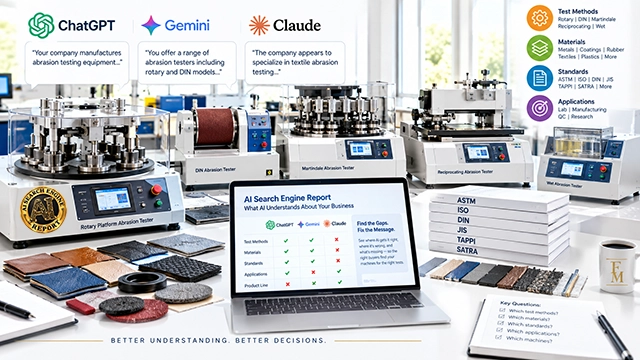
AI Search Engine Report for Abrasion Testing Machines Manufacturing
| How I Score Abrasion Testing Machines Manufacturing business in my AI Search Engine Report | |
| Does AI understand what your business is? | 20 Points |
| Does AI understand what you actually sell or provide? | 20 Points |
| Does AI understand who your business is for? | 15 Points |
| Does AI understand what makes your business different? | 15 Points |
| Does AI know when your business belongs in the conversation? | 15 Points |
| What does AI have wrong, missing, or confused? | 10 Points |
| Do ChatGPT, Claude, and Gemini understand your business the same way? | 5 Points |
| Total points available 100 points | |
A manufacturer can be correctly identified as an abrasion testing machine company by ChatGPT, Gemini, and Claude while the AI systems still misunderstand what its instruments actually test.
Does AI know whether your company manufactures rotary platform abrasion testers, DIN abrasion machines, Martindale systems, linear or reciprocating testers, wet abrasion equipment, or several different types? Does it understand the materials your machines are designed to evaluate? Does it associate the right ASTM, ISO, DIN, JIS, TAPPI, SATRA, or other standards with your equipment?
Those distinctions can determine whether an abrasion testing machine is appropriate for a laboratory, manufacturer, testing facility, or quality control department.
An AI Search Engine Report shows you what ChatGPT, Gemini, and Claude currently understand about your abrasion testing machine manufacturing business, what they associate with your products, and where their descriptions agree or differ.
What Does AI Understand About Your Abrasion Testing Machine Manufacturing Business?
Recognizing that your company manufactures abrasion testing equipment is only the beginning.
Abrasion testing covers very different test methods.
A rotary platform machine can abrade a rotating specimen with abrasive wheels. A DIN abrasion tester can measure wear of rubber and elastomers using a rotating drum and abrasive sheet. Martindale equipment uses a different movement and is commonly associated with textiles and related materials. Other equipment is designed for reciprocating abrasion, wet scrub testing, rubbing, scratch testing, or specialized wear applications.
The equipment cannot necessarily be substituted simply because all of it measures some form of abrasion or wear.
That creates an important question for a manufacturer:
Does AI understand which abrasion tests your machines actually perform?
ChatGPT could correctly recognize your company as a testing equipment manufacturer but associate it primarily with Taber type machines when you manufacture a much broader range.
Gemini might identify the correct product families while overlooking an important material application.
Claude might understand the applications but associate a machine with standards it was not designed to support.
Each answer could contain accurate information while giving a buyer a different understanding of your company.
The Test Method Matters as Much as the Machine Category
Someone looking for an abrasion testing machine often needs equipment for a particular test method, not simply a machine capable of creating wear.
A laboratory testing organic coatings under ASTM D4060 has a specific testing requirement. A rubber manufacturer evaluating abrasion according to a DIN or ISO method may need a completely different machine. A textile laboratory evaluating fabric durability can have another set of requirements.
The test motion can differ.
The specimen geometry can differ.
Loads, abrasive media, wheels, drums, test cycles, speeds, fixtures, evaluation methods, and environmental conditions can differ.
If an AI system reduces a manufacturer’s product line to “abrasion testers,” it may correctly identify the general category while missing the information that determines whether the equipment is suitable for a buyer’s actual test.
For manufacturers selling technical laboratory equipment, that distinction matters.
Does AI Associate Your Machines With the Correct Standards?
Standards can be central to abrasion testing equipment selection.
Manufacturers may describe machines in connection with specific ASTM, ISO, DIN, JIS, TAPPI, SATRA, or other test methods. Individual instruments may support several standards, while another machine from the same manufacturer supports an entirely different group.
A broad AI summary can easily flatten those distinctions.
Suppose someone asks an AI system for manufacturers of equipment suitable for a particular abrasion standard.
The usefulness of the answer depends on whether the model understands more than the manufacturer’s general product category. It needs to associate the company with the appropriate instrument and understand that instrument’s relationship to the requested test.
A manufacturer can therefore have strong recognition for abrasion testing equipment and weak understanding at the standards level.
That is a meaningful difference.
Materials Can Change Which Abrasion Tester Belongs in the Conversation
Abrasion testing machines are used across a wide range of materials and industries.
Depending on the equipment, applications can include coatings, rubber, elastomers, plastics, textiles, leather, flooring, laminates, paper, ceramics, glass, painted surfaces, footwear components, automotive materials, and construction products.
But a machine suitable for one material or test procedure is not automatically the right instrument for another.
This creates another layer of AI understanding.
Does ChatGPT associate your company with testing coatings but miss your rubber testing equipment?
Does Gemini recognize your textile testing products but overlook equipment sold for plastics?
Does Claude describe your company as a general laboratory instrument manufacturer without understanding that abrasion and wear testing is a significant specialty?
Those differences can affect when the manufacturer appears relevant during AI assisted product research.
Accessories and Configurations Are Part of the Product
The main machine is not always the complete testing system.
Abrasion testing can involve different abrasive wheels, weights, specimen holders, cutters, fixtures, abrasive sheets, reference materials, vacuum systems, grit feeders, test heads, software, or other accessories depending on the test method and equipment.
Machine configurations can also differ.
A buyer may need a particular load, rotational speed, specimen size, number of testing stations, test head, or accessory to conduct the required procedure.
If AI knows the base machine but does not understand its configurations or supporting equipment, the resulting description may still be incomplete.
This is particularly important when a manufacturer has developed a broad equipment ecosystem rather than a single abrasion tester.
Manufacturer, Distributor, and Testing Laboratory Are Different Businesses
Technical testing equipment creates another potential source of category confusion.
A company that designs and manufactures abrasion testing machines is not the same thing as a distributor that resells instruments made by other companies. Neither is the same as an independent laboratory that performs abrasion testing for customers.
Some businesses may perform more than one of these roles, but AI should not assume they are interchangeable.
For an actual manufacturer, useful AI understanding may include whether the company designs its own instruments, what equipment it produces, what markets it serves, where it sells, and what technical support or calibration related services it provides.
If a model understands the products but misunderstands the company’s role in the supply chain, someone researching manufacturers could receive the wrong impression.
Product Lines Change and Technical Information Can Become Outdated
Abrasion testing equipment manufacturers can introduce new models, discontinue older ones, revise specifications, add standards, expand accessories, or change product naming.
That creates opportunities for interpretation drift.
An AI model could associate the company with an older model that has been replaced.
Another could find the current machine but omit newer applications.
A third could combine specifications from different models or generations into a description that sounds technically credible but does not accurately represent any current product.
For technical equipment, these errors can be especially difficult to recognize because the answer may contain the right terminology.
The presence of technical language does not prove that the underlying understanding is correct.
Recommendation Context Is Highly Specific for Abrasion Testing Equipment
A buyer rarely needs “the best abrasion tester” without additional context.
A useful recommendation may depend on the material being tested, applicable standard, required test motion, specimen dimensions, load, abrasive medium, laboratory workflow, test volume, desired automation, data requirements, budget, geographic availability, and support requirements.
This means a manufacturer may belong in one AI recommendation and not another.
If ChatGPT understands that your company makes rotary abrasion testers but does not know about your DIN equipment, it could omit the company from a rubber testing equipment comparison.
If Gemini associates your company strongly with textile testing, it might overlook a machine relevant to coatings.
If Claude has broader product understanding, the same company might appear in both conversations.
The question is therefore not merely whether AI recognizes the manufacturer.
It is whether AI understands when the manufacturer’s equipment belongs in the conversation.
Three AI Models Can Understand the Same Manufacturer Differently
ChatGPT, Gemini, and Claude do not necessarily build identical pictures of an abrasion testing machine manufacturer.
One model might have excellent product category recognition but weak standards associations.
Another might understand the standards but overlook part of the current product line.
A third might identify the machines and applications correctly while misunderstanding whether the company is a manufacturer or distributor.
Looking at a single AI answer cannot reveal those differences.
Cross model comparison shows where the company’s identity and products are understood consistently and where the picture changes depending on which AI system someone uses.
AI Search Engine Report for Abrasion Testing Machines Manufacturing
I manually evaluate your business across ChatGPT, Gemini, and Claude to determine how the three systems currently understand your company.
The analysis goes beyond whether they recognize your name.
I examine what type of company the models believe you are, which abrasion testing machines they associate with you, what applications and customers they connect with the business, what attributes they assign to the company, when they consider your products relevant, what appears missing or incorrect, and where the three AI systems disagree.
The findings are evaluated using the AI Search Engine Report methodology, which measures seven areas of AI understanding and produces an AI Business Understanding Score from 0 to 100.
This is a manual diagnostic analysis. It is not an automated website scan, traditional SEO audit, search ranking report, or software generated visibility score.
The purpose is to establish what the AI systems currently understand about the manufacturer before deciding whether anything deserves attention.
What Could an Abrasion Testing Machine Manufacturer Learn From the Report?
The findings depend on the individual company.
The analysis could show that ChatGPT, Gemini, and Claude understand the manufacturer, its product range, and its applications accurately.
It could instead reveal that an important machine family is missing, an obsolete model is still strongly associated with the company, or a model confuses the manufacturer with a distributor or testing laboratory.
The AI systems could disagree about materials tested, industries served, geographic markets, standards associated with particular products, or attributes that distinguish the manufacturer from alternatives.
The report can also identify areas where all three models agree.
The purpose is not to manufacture a problem. It is to document the understanding that actually exists.
Sometimes the evidence reveals meaningful gaps. Sometimes it shows that the manufacturer is already understood accurately and consistently.
Either result replaces assumption with evidence.
What You Receive
The AI Search Engine Report is a $495 one time purchase.
Your business is manually evaluated across ChatGPT, Gemini, and Claude. You receive a 10+ page PDF report documenting the findings, including what the models understand, important misunderstandings or omissions, attributes associated with the company, recognition and recommendation patterns, cross model agreements and disagreements, strategic observations, and recommendations based on what the analysis finds.
The completed report is delivered the next business day after the analysis is completed.
I do not sell SEO, GEO, AEO, AI visibility optimization, or implementation services after the report.
The report provides the diagnosis and recommendations. What you decide to do with the findings remains your decision.
Do ChatGPT, Gemini, and Claude Understand Your Abrasion Testing Machine Business Correctly?
AI can correctly identify your company as an abrasion testing machine manufacturer while misunderstanding the machines you manufacture, the test methods they perform, the materials they evaluate, the standards associated with them, or the situations in which your equipment is relevant.
For a technical equipment manufacturer, the difference between recognition and accurate product understanding can be substantial.
You cannot determine that simply by finding the company name in an AI answer.
You have to examine what the models actually understand.
The AI Search Engine Report provides that evidence across ChatGPT, Gemini, and Claude in one manual analysis.
Order your AI Search Engine Report for $495.
