
AI Search Engine Report for Abattoirs
An abattoir can be correctly identified by ChatGPT, Gemini, and Claude and still be substantially misunderstood.
| How I Score Abattoir business in my AI Search Engine Report | |
| Does AI understand what your business is? | 20 Points |
| Does AI understand what you actually sell or provide? | 20 Points |
| Does AI understand who your business is for? | 15 Points |
| Does AI understand what makes your business different? | 15 Points |
| Does AI know when your business belongs in the conversation? | 15 Points |
| What does AI have wrong, missing, or confused? | 10 Points |
| Do ChatGPT, Claude, and Gemini understand your business the same way? | 5 Points |
| Total points available 100 points | |
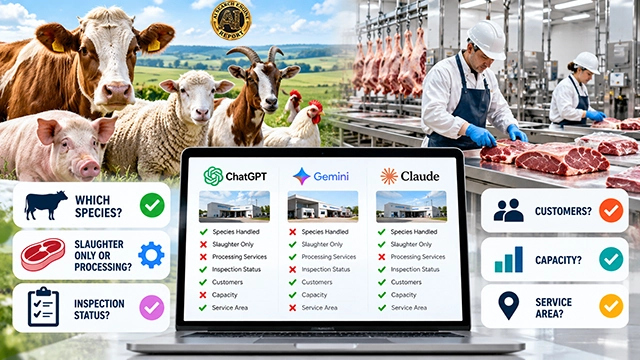
Does AI know which livestock your facility handles? Does it understand whether you provide slaughter only or additional meat processing services? Does it correctly understand your inspection status, customers, capacity, service area, or the difference between inspected and custom work?
Those distinctions can completely change whether an abattoir is relevant to someone researching livestock slaughter or meat processing options.
An AI Search Engine Report shows you what ChatGPT, Gemini, and Claude currently understand about your abattoir, where their descriptions agree, and where important details are wrong, missing, or inconsistent.
What Does AI Understand About Your Abattoir?
The word abattoir describes the general category. It does not tell someone enough to determine whether a particular facility meets their needs.
A cattle producer looking for a slaughter facility has different requirements from someone with sheep or goats. A livestock owner seeking custom slaughter is asking a different question from a commercial meat business that needs inspected product. A customer looking for slaughter, carcass chilling, cutting, packaging, or other processing needs to know which of those services the facility actually provides.
ChatGPT might correctly identify an establishment as an abattoir while misunderstanding one or more of those distinctions.
Gemini could associate the facility with livestock species it does not handle.
Claude could correctly describe the slaughter operation but omit processing capabilities that are important to potential customers.
All three models could know the business exists while giving three materially different pictures of what the facility actually does.
That is the problem an AI Search Engine Report examines.
Species Matter More Than the Category
An abattoir is not automatically an appropriate facility for every type of livestock.
Cattle, hogs, sheep, goats, poultry, and other animals involve different facilities, equipment, handling requirements, inspection considerations, and operating capabilities. Individual establishments may specialize in one species, accept several, or operate different parts of the facility for different animals.
This creates a basic AI understanding question:
Does AI know which animals your abattoir actually accepts?
A model that incorrectly associates a cattle operation with hog processing has not made a minor descriptive error. It has misunderstood a basic part of the business.
The opposite problem matters too. An abattoir may handle multiple species while an AI model recognizes only one. Someone asking for a facility capable of processing sheep or goats could receive an incomplete picture even though the model correctly identifies the company as an abattoir.
The business category can therefore be correct while the useful understanding underneath it is wrong.
Does AI Understand Slaughter Versus Processing?
The distinction between slaughter and further processing is another area where a broad description can hide important differences.
Some establishments primarily perform slaughter and carcass handling. Others may provide additional services such as chilling, aging, cutting, deboning, grinding, wrapping, packaging, freezing, or other processing.
A facility can also perform different combinations of services for different customers.
If AI collapses all of those activities into the generic description “meat processing,” the answer may sound reasonable while failing to explain what the business actually offers.
For an abattoir owner, the important question is not simply whether ChatGPT, Gemini, and Claude recognize that the company works with meat.
It is whether the models understand where the company’s work begins, where it ends, and what a customer can actually have done there.
Inspection Status Can Change the Meaning of an AI Recommendation
Inspection and exemption status are especially important when AI systems describe or recommend slaughter facilities.
Federally inspected establishments, state inspected operations, and custom exempt operations are not interchangeable categories. The distinction can affect what happens to the resulting meat and whether it can enter commercial channels.
An AI answer that ignores that distinction can therefore recommend a real abattoir for the wrong type of need.
Consider two questions:
“Where can I have my steer processed for my family’s use?”
and
“Which slaughter facility can process cattle for meat I intend to sell?”
Those questions can require materially different answers even though both people may appear to be searching for an abattoir.
An AI system needs more than the business name and location to make that distinction correctly. It needs an accurate understanding of the establishment and the type of work it performs.
Capacity and Customer Type Can Affect Whether an Abattoir Is Relevant
Two abattoirs can process the same species and still serve very different markets.
One may primarily serve individual livestock owners and small farms. Another may work with commercial producers, meat companies, wholesalers, retailers, or other higher volume customers. Facilities can differ substantially in throughput, scheduling, minimum volumes, processing arrangements, and the geographic area from which they accept livestock.
These details influence when an abattoir belongs in an AI recommendation.
A technically accurate recommendation can still be unhelpful if the facility is the wrong operational fit for the person asking.
This is where AI understanding becomes more important than simple business recognition.
The question is not merely:
Does AI know this abattoir exists?
The better question is:
Does AI understand enough about the operation to know when this particular abattoir is relevant?
Important Operational Details Can Disappear From AI Descriptions
Abattoirs have operational characteristics that may matter considerably to livestock producers and commercial customers but may not appear consistently across AI systems.
These can include the species accepted, inspection status, slaughter services, further processing capabilities, chilling or cold storage, scheduling, customer types, service area, capacity, specialty processing, and other characteristics of the facility.
Information can also change.
A facility can add or discontinue a service. Processing capabilities can change. Inspection arrangements can change. Species accepted can change. Ownership, operating schedules, locations, or customer policies can change.
An AI system may find part of the current picture and combine it with older or incomplete information.
That can produce an answer that is not obviously false. It may simply describe an earlier or incomplete version of the business.
For the owner, that can be harder to detect than a completely incorrect answer.
Three AI Models Can Describe the Same Abattoir Differently
There is no reason to assume ChatGPT, Gemini, and Claude have formed identical conclusions about the same facility.
ChatGPT might recognize the correct species and slaughter services but miss further processing.
Gemini might provide a broader description of the facility while being unclear about who it serves.
Claude might understand the operation well but omit an important service that would affect whether someone considers the business.
One model could also associate attributes with the abattoir that the other two never mention.
Looking at one AI response cannot show that disagreement.
Cross model comparison matters because someone researching an abattoir through ChatGPT may receive a different understanding of the company than someone asking essentially the same question through Gemini or Claude.
AI Search Engine Report for Abattoirs
I manually evaluate your abattoir across ChatGPT, Gemini, and Claude to determine how the three systems currently understand the business.
The analysis looks beyond whether the models recognize the company name.
I examine what they believe the business is, what services they associate with it, who they believe it serves, what attributes they connect with the operation, when they consider the business relevant, what appears missing or incorrect, and where the three models disagree.
The findings are evaluated using the AI Search Engine Report methodology, which measures seven areas of AI understanding and produces an AI Business Understanding Score from 0 to 100.
This is a manual diagnostic analysis. It is not an automated website scan, traditional SEO audit, ranking report, or software generated visibility score.
The purpose is to establish what the AI systems currently understand before deciding whether anything needs attention.
What Could an Abattoir Learn From the Report?
The findings depend entirely on the individual business.
The analysis might show that all three models understand the abattoir accurately and consistently.
It could instead reveal that one model associates the facility with the wrong livestock species, that an important processing capability is missing, or that the models disagree about the customers the facility serves.
The analysis could find outdated information, incomplete descriptions, incorrect attributes, uncertainty about the operation, or situations where the business appears relevant to one AI system but not another.
It can also show where the models agree.
That matters because the purpose of the report is not to manufacture a problem. It is to document what is actually there.
Sometimes the evidence identifies meaningful misunderstandings. Sometimes it shows that AI already has a strong understanding of the business.
Either finding replaces assumption with evidence.
What You Receive
The AI Search Engine Report is a $495 one time purchase.
Your abattoir is manually evaluated across ChatGPT, Gemini, and Claude. You receive a 10+ page PDF report documenting the findings, including how the models understand the business, important misunderstandings or omissions, attributes associated with the company, recognition and recommendation patterns, cross model agreements and disagreements, strategic observations, and recommendations based on what the analysis finds.
The completed report is delivered the next business day after the analysis is completed.
I do not sell SEO, GEO, AEO, AI visibility optimization, or implementation services after the report.
The report provides the diagnosis and recommendations. What you decide to do with those findings remains your decision.
Do ChatGPT, Gemini, and Claude Understand Your Abattoir Correctly?
Your abattoir can be correctly named and categorized while AI still misunderstands the species you handle, the services you provide, the customers you serve, your inspection context, or the circumstances in which your facility should be considered.
You cannot determine that from whether your company merely appears in an AI answer.
You have to examine what the models actually understand.
The AI Search Engine Report gives you that evidence across ChatGPT, Gemini, and Claude in one manual analysis.
Order your AI Search Engine Report for $495.
