
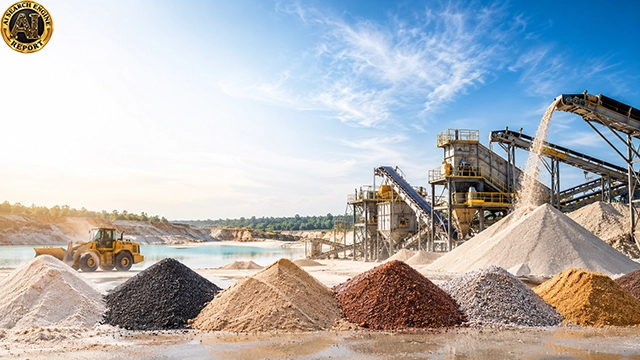
| How I Score Abrasive Sand Quarrying and/or Beneficiating businesses in my AI Search Engine Report | |
| Does AI understand what your business is? | 20 Points |
| Does AI understand what you actually sell or provide? | 20 Points |
| Does AI understand who your business is for? | 15 Points |
| Does AI understand what makes your business different? | 15 Points |
| Does AI know when your business belongs in the conversation? | 15 Points |
| What does AI have wrong, missing, or confused? | 10 Points |
| Do ChatGPT, Claude, and Gemini understand your business the same way? | 5 Points |
| Total points available 100 points | |
AI Search Engine Report for Abrasive Sand Quarrying and/or Beneficiating
An abrasive sand quarrying or beneficiating operation can be correctly recognized by ChatGPT, Gemini, and Claude as an industrial sand business while the AI systems still misunderstand what material the company actually produces, how that material is processed, or the applications it is intended to serve.
Does AI understand whether your operation produces abrasive sand, blast sand, grinding sand, foundry sand, filtration sand, glass sand, silica sand, or several industrial sand products? Does it understand whether you quarry, dredge, wash, screen, grind, size, or otherwise beneficiate the material? Does it distinguish your industrial sand from ordinary construction sand?
Those distinctions can determine whether your company belongs in a buyer’s research at all.
An AI Search Engine Report shows you what ChatGPT, Gemini, and Claude currently understand about your abrasive sand quarrying or beneficiating business, what products and applications they associate with the company, and where their descriptions agree or differ.
What Does AI Understand About Your Abrasive Sand Quarrying and/or Beneficiating Business?
Knowing that your company produces sand is not enough.
Industrial sand can be produced for very different applications. Abrasive or blast sand is not automatically interchangeable with construction sand, filtration sand, foundry sand, glass sand, or other industrial grades.
The way the material is prepared can matter as well.
An operation may extract material and then wash, screen, grind, size, or otherwise beneficiate it to produce material with characteristics required by particular customers or applications.
That creates a central question:
Does AI understand what your operation actually produces?
ChatGPT could correctly identify your company as a sand producer while describing it primarily as a construction aggregate operation.
Gemini might understand that the company produces industrial sand but associate it with applications the operation does not serve.
Claude could identify the correct end markets while missing an important processing or beneficiation capability.
All three systems could recognize the company and still give potential buyers substantially different pictures of the business.
Industrial Sand and Construction Sand Are Different Markets
One of the most important distinctions for AI to understand is the difference between industrial grade sand and ordinary construction grade sand.
Abrasive sand quarrying and beneficiating falls within the industrial sand category. Industrial sand can be produced for applications including abrasive blasting, grinding, foundry work, filtration, glass production, molding, and other specialized uses.
Construction sand serves a different market.
If an AI system sees references to a quarry, sand pit, screening equipment, washing operations, bulk material, or truck shipments, it could understand the general activity while getting the commercial category wrong.
That matters when someone asks AI to identify an abrasive sand supplier or an industrial sand producer for a particular application.
A company can be a major sand operation and still be irrelevant to that request if it produces only construction grade material.
Likewise, an abrasive sand operation should not disappear from an industrial sand recommendation because an AI system has incorrectly categorized it as a general aggregate producer.
Quarrying and Beneficiating Tell AI Different Things About the Operation
Extraction is only part of the business.
Beneficiation can include processes such as washing, screening, grinding, sizing, and other mechanical preparation of mined material.
For an abrasive sand operation, those capabilities can help define the product being sold.
AI therefore needs to understand whether the company simply extracts raw material, prepares material after extraction, operates a preparation facility, or performs several stages of the process.
This distinction can become blurred online.
A company may be described as a quarry in one source, an industrial sand producer in another, and a processing operation somewhere else. Equipment pages, permits, directories, product listings, and older company descriptions may emphasize different parts of the operation.
An AI system could accurately identify the quarry while failing to understand the beneficiation work that turns extracted material into the company’s commercial products.
Another model could understand the processed products but have a weak picture of where the material originates.
For a vertically integrated operation, either interpretation would be incomplete.
Abrasive Sand Is Not One Uniform Product
The word “abrasive” does not make every abrasive sand equivalent.
Material characteristics and specifications can determine whether a product is suitable for a particular abrasive application. Particle size and distribution, mineral composition, hardness, cleanliness, moisture, shape, consistency, and other characteristics can matter depending on what the customer is trying to accomplish.
An operation may also offer different grades or sizes for different applications.
AI can therefore understand the general product category while missing the distinctions that actually define the product line.
If ChatGPT knows that your company sells blast sand but does not understand the grades available, its picture is incomplete.
If Gemini associates your material with abrasive blasting but misses other industrial applications, it may define the company too narrowly.
If Claude understands several applications but associates the company with a material or specification it does not produce, the description can sound plausible while still being wrong.
For a specialized industrial material producer, product recognition and product understanding are not the same thing.
End Use Can Be as Important as the Material Name
Industrial sand is often researched according to what the buyer needs the material to do.
A buyer looking for blast media is asking a different question from a foundry researching molding sand, a filtration operation sourcing filter media, or a glass producer evaluating raw materials.
The same company may belong in several of those conversations if it produces appropriate materials.
Or it may specialize in only one.
This is where broad AI categorization can become misleading.
An AI system that simply describes a company as an “industrial sand supplier” may technically be correct while providing little information about when that supplier is actually relevant.
Useful AI understanding requires the connection between the company, the material it produces, and the applications that material serves.
Does AI Understand the Markets You Actually Serve?
An abrasive sand quarrying or beneficiating operation can serve local, regional, national, or specialized industrial markets.
Transportation matters because sand is a physical bulk product. Quarry location, processing location, shipping capabilities, access to truck or rail transportation, and practical service territory can influence which customers an operation can economically serve.
AI can misunderstand this part of the business too.
A model might correctly identify your products but assume the company serves only the immediate area around the quarry.
Another could describe the company as a national supplier when its actual distribution footprint is more limited.
A third could overlook an important market reached through distributors or transportation infrastructure.
For someone asking AI where to source abrasive sand, understanding what the company sells without understanding where and how it sells it can produce an incomplete recommendation.
Abrasive Sand Can Be Confused With Manufactured Abrasive Products
There is another category distinction that matters.
A company that quarries or beneficiates abrasive sand is not automatically an abrasive product manufacturer.
Manufacturers can produce grinding wheels, coated abrasives, sandpaper, polishing products, and other finished abrasive products. Your operation is farther upstream, producing or preparing the mineral material itself.
That distinction is important when AI interprets related terminology across the abrasive industry.
Someone researching abrasive products manufacturing has a different need from someone looking for a quarry or beneficiating operation supplying industrial abrasive sand.
Likewise, an abrasion testing machine manufacturer operates in another related but fundamentally different category.
AI can encounter the same words such as abrasive, abrasion, grinding, grit, and testing across these industries. Accurate understanding requires the model to determine where your company actually sits in that chain.
Current Products and Capabilities Can Be Misrepresented by Older Information
Quarrying and mineral processing businesses can change over time.
A company can add processing equipment, expand capacity, introduce new grades, enter or leave particular markets, change product names, acquire additional reserves, modify shipping capabilities, or discontinue older products.
Historical information does not necessarily disappear when those changes occur.
Old directories, product pages, regulatory documents, distributor information, archived specifications, and third party descriptions can continue to describe an earlier version of the operation.
An AI answer can therefore contain real information about the company and still present an outdated picture.
One model might associate the operation with a market it no longer serves.
Another might miss a newer product or beneficiation capability.
A third could combine current and historical information into one description.
The question is not simply whether AI found information about the company.
The question is whether the resulting interpretation represents the operation as it exists now.
Recommendation Context Depends on the Buyer’s Requirement
There is no universally appropriate abrasive sand supplier for every industrial requirement.
A useful recommendation can depend on material type, particle size, intended application, specifications, processing, required volume, consistency, location, transportation, availability, and other purchasing requirements.
That means your company may belong in one AI recommendation and not another.
If ChatGPT understands your abrasive blasting material but misses another industrial grade you produce, the company could disappear from research involving that application.
If Gemini understands the product range but gets your geographic market wrong, it could exclude the operation from a sourcing question it should qualify for.
If Claude understands both, the same company could receive a much broader interpretation.
Recognition alone does not tell you whether AI understands when your operation belongs in the conversation.
Three AI Models Can Understand the Same Sand Operation Differently
ChatGPT, Gemini, and Claude do not necessarily form the same picture of an abrasive sand quarrying and beneficiating business.
One model could understand that the company produces industrial rather than construction sand but miss important applications.
Another might understand the applications but have an incomplete picture of beneficiation capabilities.
A third could understand the operation and products while getting its geographic market or customer base wrong.
Looking at one AI answer cannot reveal those differences.
Comparing all three shows where the company’s identity, products, processing capabilities, applications, markets, and attributes are understood consistently and where the interpretation changes depending on the AI system being used.
AI Search Engine Report for Abrasive Sand Quarrying and/or Beneficiating
I manually evaluate your business across ChatGPT, Gemini, and Claude to determine how the three AI systems currently understand your company.
The analysis goes beyond whether they recognize the business name.
I examine what type of operation the models believe you are, which abrasive or industrial sand products they associate with the business, what processing and beneficiation capabilities they understand, which applications and customers they connect with the company, what attributes they assign to the operation, when they consider your products relevant, what appears missing or incorrect, and where the three models disagree.
The findings are evaluated using the AI Search Engine Report methodology, which measures seven areas of AI understanding and produces an AI Business Understanding Score from 0 to 100.
This is a manual diagnostic analysis. It is not an automated website scan, traditional SEO audit, search ranking report, or software generated visibility score.
The purpose is to establish what the AI systems currently understand about the business before deciding whether anything deserves attention.
What Could an Abrasive Sand Operation Learn From the Report?
The findings depend on the individual company.
The analysis could show that ChatGPT, Gemini, and Claude accurately understand the operation, the industrial sand products it produces, its beneficiation capabilities, applications, customers, and geographic market.
It could instead reveal that the business is being interpreted as a construction sand operation, an important industrial grade is missing, a model associates the company with an application it does not serve, or current processing capabilities are not understood.
The models could disagree about whether the company primarily quarries, beneficiates, or performs both activities. They could have different interpretations of product grades, end uses, distribution territory, or the attributes that distinguish the operation from alternative suppliers.
The report can also show where all three models agree.
The purpose is not to manufacture a problem. It is to document the understanding that actually exists.
Sometimes the evidence identifies meaningful gaps. Sometimes it confirms that the operation is already understood accurately and consistently.
Either result replaces assumption with evidence.
What You Receive
The AI Search Engine Report is a $495 one time purchase.
Your business is manually evaluated across ChatGPT, Gemini, and Claude. You receive a 10+ page PDF report documenting the findings, including what the models understand, important misunderstandings or omissions, attributes associated with the company, recognition and recommendation patterns, cross model agreements and disagreements, strategic observations, and recommendations based on what the analysis finds.
The completed report is delivered the next business day after the analysis is completed.
I do not sell SEO, GEO, AEO, AI visibility optimization, or implementation services after the report.
The report provides the diagnosis and recommendations. What you decide to do with the findings remains your decision.
Do ChatGPT, Gemini, and Claude Understand Your Abrasive Sand Quarrying and/or Beneficiating Business Correctly?
AI can correctly recognize your company as a sand producer while misunderstanding whether you produce industrial or construction sand, which abrasive materials and grades you offer, how those materials are beneficiated, which applications they serve, where you sell them, or when your operation should be recommended.
For an industrial mineral operation, knowing the company exists is not the same as understanding what the company produces.
You cannot determine that simply by finding your company name in an AI answer.
You have to examine what the models actually understand.
The AI Search Engine Report provides that evidence across ChatGPT, Gemini, and Claude in one manual analysis.
Order your AI Search Engine Report for $495.

About Frank Masotti
Frank Masotti personally conducts every AI Search Engine Report for businesses involved in Abrasive Sand Quarrying and/or Beneficiating.