
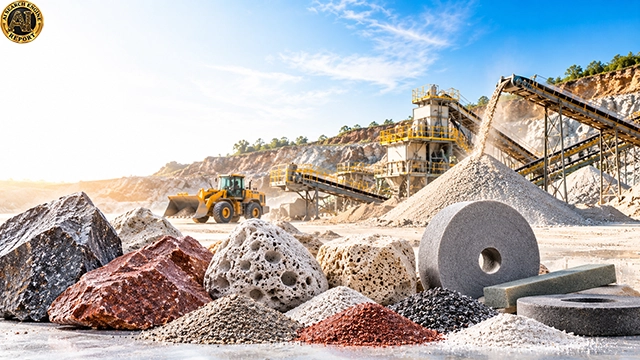
AI Search Engine Report for Abrasive Stones (e.g., Emery, Grindstones, Hones, Pumice) Mining and/or Beneficiating
| How I Score Abrasive Stones Mining businesses in my AI Search Engine Report | |
| Does AI understand what your business is? | 20 Points |
| Does AI understand what you actually sell or provide? | 20 Points |
| Does AI understand who your business is for? | 15 Points |
| Does AI understand what makes your business different? | 15 Points |
| Does AI know when your business belongs in the conversation? | 15 Points |
| What does AI have wrong, missing, or confused? | 10 Points |
| Do ChatGPT, Claude, and Gemini understand your business the same way? | 5 Points |
| Total points available 100 points | |
A company can mine or beneficiate abrasive stone and still be understood very differently by ChatGPT, Gemini, and Claude.
Does AI understand which natural abrasive materials your operation actually produces? Does it distinguish mining from processing and beneficiation? Does it know whether your material is sold for grinding, polishing, surface preparation, nonskid applications, construction, filtration, horticulture, or another end use?
Those distinctions matter because the mineral alone does not necessarily define the market.
An AI Search Engine Report shows you what ChatGPT, Gemini, and Claude currently understand about your abrasive stone mining or beneficiating business, which products and markets they associate with the company, and where their interpretations agree or differ.
What Does AI Understand About Your Abrasive Stone Mining and/or Beneficiating Business?
Knowing that a company works with natural abrasive stone is only the beginning.
An operation may mine pumice, emery, or another naturally occurring abrasive material. It may extract raw material and sell it with limited processing, or it may crush, screen, size, grade, wash, dry, blend, or otherwise beneficiate material for particular commercial uses.
The resulting products can serve very different customers.
Abrasive applications may involve grinding, polishing, surface finishing, or other forms of material removal. Some minerals can also enter markets that have little to do with abrasives.
Pumice is a particularly good example. The same general mineral commodity can be associated with abrasives, lightweight aggregate, concrete products, horticulture, filtration, absorbent applications, and other uses.
That creates an important question:
Does AI understand the part of the mineral market your company actually serves?
ChatGPT could correctly identify your company as a pumice producer while describing it primarily as a construction aggregate supplier.
Gemini might recognize abrasive applications but overlook other important grades or markets.
Claude could understand the products but describe the business as a quarry or general mineral supplier without recognizing the beneficiation that turns mined material into commercial products.
All three models could recognize the company while presenting substantially different versions of what it actually does.
Mineral Identity Is Only the First Layer
Natural abrasive stones are not interchangeable.
Emery, pumice, and other abrasive minerals have different physical characteristics and commercial applications. Even material within a single mineral category can be processed and sold differently depending on particle size, grade, composition, hardness, porosity, and intended use.
For an abrasive stone operation, AI needs to get the underlying mineral identity right.
But that alone is not enough.
If your company mines pumice and produces specific processed grades, simply describing the company as a “pumice mine” leaves out an important part of the business.
Likewise, a company producing natural emery for abrasive or wear resistant applications should not automatically be treated as equivalent to every company associated with abrasive minerals.
Accurate AI understanding requires the connection between the mineral, the processing performed, the resulting product, and its commercial application.
Mining and Beneficiating Are Different Parts of the Business
Extraction tells only part of the story for many mineral operations.
Material coming from a deposit may require processing before it has the properties, consistency, or particle distribution required by a customer.
Depending on the operation and mineral, beneficiation can include crushing, screening, sizing, grading, drying, or other processing.
Those steps can help determine what the company ultimately sells.
An AI system might understand where a company mines material but know very little about what happens after extraction. Another model could find information about processed products and fail to recognize that the company controls the mineral source itself.
That difference changes the description of the business.
It can also affect which companies AI considers relevant when someone asks for a producer, miner, processor, beneficiator, or supplier of a particular natural abrasive material.
Pumice Creates an Unusual AI Classification Problem
Pumice demonstrates why broad mineral recognition can be misleading.
Pumice has commercial uses extending well beyond abrasives. It is used in building products and aggregates as well as applications involving abrasives, filtration, absorbency, horticulture, and other markets.
A company associated strongly with pumice could therefore be placed into several legitimate commercial categories.
The problem is not that those categories are necessarily wrong.
The problem is whether they accurately describe your company.
If your operation specializes in abrasive grades of pumice, an AI answer centered on horticultural pumice could give a buyer the wrong impression.
If you primarily serve construction markets, an AI system that emphasizes polishing applications could create the opposite problem.
A diversified producer creates another possibility. AI may understand one major market while completely overlooking the others.
For this business type, the question is therefore more specific than whether AI knows what pumice is.
It is whether AI understands what your operation does with it.
Product Grade Can Determine the Customer
A mined mineral becomes commercially meaningful through the specifications customers actually purchase.
Particle size can matter. Purity and composition can matter. Physical characteristics can matter. Processing can matter. Packaging and available quantities can matter.
Different customers can consequently be looking for very different versions of what appears at first glance to be the same natural material.
A broad description such as “supplier of natural abrasives” may be technically correct while providing almost no useful information about which buyers the company can actually serve.
AI could also associate a producer with an application for which its available grades are unsuitable.
That is an important distinction when evaluating AI recommendations.
The useful question is not merely whether ChatGPT, Gemini, or Claude recognizes the material.
It is whether the models connect the right material and grade with the right customer and application.
Natural and Manufactured Abrasives Can Be Confused
Abrasive markets contain both naturally occurring materials and manufactured abrasive products.
That creates another potential category problem.
A company mining and beneficiating natural abrasive stone is not automatically an abrasive products manufacturer. Nor should it necessarily be interpreted as a manufacturer of synthetic abrasive grains, bonded grinding wheels, coated abrasives, or finished abrasive tools.
Those companies may participate in related supply chains without performing the same function.
This distinction becomes especially important when someone asks an AI system for a source of natural abrasive material.
A model that understands only the broad term “abrasives” can mix miners, mineral processors, abrasive manufacturers, distributors, and finished product suppliers into the same answer.
For comparison, abrasive points, wheels, and disks for dental manufacturing represents a very different part of the abrasive supply chain.
Correct category understanding should preserve that difference.
Deposit Location and Markets Served Are Separate Questions
Mining is inherently tied to geology and location.
The mineral deposit determines where extraction can occur.
The market does not necessarily stop there.
An abrasive stone producer may ship processed material well beyond the location of its mine or processing facility. Customers may be regional, national, or international depending on the material, economics, available grades, and markets served.
AI therefore needs to distinguish between where the material comes from and where the company does business.
A model could know the mine location but underestimate the company’s commercial reach.
Another could recognize a broader market presence without correctly identifying the company’s actual source or processing operation.
For buyers searching for producers in a particular region or for companies capable of supplying material to their location, those are different pieces of information.
Recommendation Context Depends on the Application
There is no single recommendation context for an abrasive stone producer.
Someone searching for natural abrasive material for polishing has different requirements from someone sourcing pumice for filtration, horticulture, construction, or an absorbent application.
Even within abrasive applications, requirements can differ according to the material being worked, desired finish, particle size, grade, and process.
A company can therefore be highly relevant to one AI recommendation and completely inappropriate for another.
If ChatGPT understands your abrasive grades but not your other mineral products, it may present too narrow a picture of the company.
If Gemini associates the business primarily with a secondary market, it could overlook the company’s core customers.
Claude could interpret the product range differently from both.
The issue is not simply whether your company appears when somebody asks AI about abrasive stone.
It is whether AI understands when your company belongs in the conversation.
Three AI Models Can Understand the Same Mineral Operation Differently
ChatGPT, Gemini, and Claude do not necessarily develop identical interpretations of an abrasive stone mining or beneficiating company.
One model could accurately identify the mineral but misunderstand the products produced from it.
Another might understand the product grades but miss an important end market.
A third could correctly identify the customers while misunderstanding whether the company mines the material, processes material obtained elsewhere, or performs both functions.
Looking at one AI answer cannot show those differences.
Comparing all three can reveal whether the company’s mineral resources, processing capabilities, products, applications, customers, and market position are understood consistently or whether the picture changes depending on which AI system a buyer uses.
AI Search Engine Report for Abrasive Stones Mining and/or Beneficiating
I manually evaluate your business across ChatGPT, Gemini, and Claude to determine how the three AI systems currently understand your company.
The analysis goes beyond whether the models recognize the business name.
I examine what type of operation they believe you run, which abrasive stones or minerals they associate with the company, what processing or beneficiation they understand, which products and grades they recognize, who they believe buys those products, which applications they associate with the material, when they consider the company relevant, what appears missing or incorrect, and where the three models disagree.
The findings are evaluated using my AI Search Engine Report methodology, which measures seven areas of AI understanding and produces an AI Business Understanding Score from 0 to 100.
This is a manual diagnostic analysis. It is not an automated website scan, traditional SEO audit, search ranking report, or software generated AI visibility score.
The purpose is to establish what the AI systems currently understand about the business before deciding whether anything deserves attention.
What Could an Abrasive Stone Producer Learn From the Report?
The answer depends on the individual operation.
The analysis could show that ChatGPT, Gemini, and Claude accurately understand the minerals the company produces, its processing capabilities, available products, applications, customers, and markets.
It could instead reveal that AI recognizes the mineral but associates the company with the wrong primary use.
One model might overlook beneficiation and describe the business only as a mining operation.
Another could confuse the company with an abrasive products manufacturer or general mineral distributor.
AI might understand the company’s pumice operations while missing another important natural abrasive material, or associate the right product with the wrong customer market.
The models could also disagree about the attributes that distinguish the company from other mineral producers.
The purpose is not to manufacture a problem.
It is to document the understanding that actually exists.
Sometimes the evidence identifies meaningful gaps. Sometimes it confirms that the company is already understood accurately and consistently.
Either result replaces assumption with evidence.
What You Receive
The AI Search Engine Report is a $495 one time purchase.
Your business is manually evaluated across ChatGPT, Gemini, and Claude. You receive a 10+ page PDF report documenting the findings, including what the models understand, important misunderstandings or omissions, attributes associated with the company, recognition and recommendation patterns, cross model agreements and disagreements, strategic observations, and recommendations based on what the analysis finds.
The completed report is delivered the next business day after the analysis is completed.
I do not sell SEO, GEO, AEO, AI visibility optimization, or implementation services after the report.
The report provides the diagnosis and recommendations. What you decide to do with the findings remains your decision.
Do ChatGPT, Gemini, and Claude Understand Your Abrasive Stone Business Correctly?
AI can know that your company mines pumice, emery, or another natural abrasive stone while still misunderstanding what you produce from it, how the material is processed, which grades you sell, which industries you serve, and when your company should be recommended.
For an abrasive stone mining or beneficiating operation, knowing the mineral name is not the same as understanding the business.
You cannot determine that simply by finding your company name in an AI answer.
You have to examine what the models actually understand.
The AI Search Engine Report provides that evidence across ChatGPT, Gemini, and Claude in one manual analysis.
Order your AI Search Engine Report for $495.

About Frank Masotti
Frank Masotti personally conducts every AI Search Engine Report for businesses involved in Abrasive Stones Mining.