
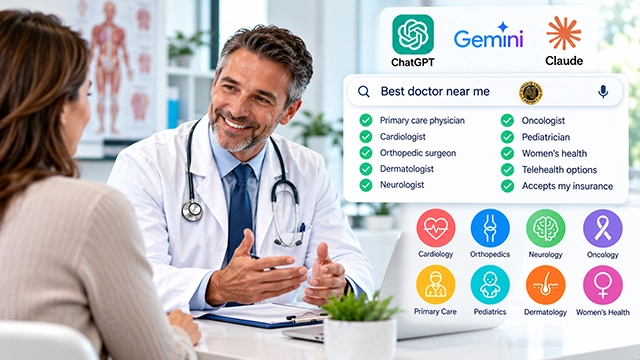
AI Search Engine Report for Doctors
How I Score a Doctor’s AI Search Performance in My AI Search Engine Report
| What I Evaluate | Points |
|---|---|
| Does AI understand what your business is? | 20 |
| Does AI understand what you actually sell or provide? | 20 |
| Does AI understand who your business is for? | 15 |
| Does AI understand what makes your business different? | 15 |
| Does AI know when your business belongs in the conversation? | 15 |
| What does AI have wrong, missing, or confused? | 10 |
| Do ChatGPT, Claude, and Gemini understand your business the same way? | 5 |
| Total points available | 100 |
The score provides one measurement of how completely, accurately, and consistently the three AI systems understand the practice. The more important information is the evidence behind that score.
A patient can ask ChatGPT, Gemini, or Claude to help find a primary care doctor, cardiologist, orthopedic surgeon, neurologist, dermatologist, oncologist, or another physician who fits a particular medical need.
They may ask for a doctor with a specific specialty, experience with a particular condition, an affiliation with a certain hospital, telehealth availability, or a practice in a convenient location.
Before an AI system can make sense of a question like that, it has to understand the doctors and medical practices that could potentially fit.
That requires considerably more than recognizing a physician’s name.
My AI Search Engine Report is a manual analysis of what ChatGPT, Gemini, and Claude currently understand about a business. For a physician or medical practice, that means examining how the three systems understand the practice, specialties, services, patient needs, attributes, geographic relevance, and other information that can affect how the doctor is interpreted.
What Does AI Understand About Your Medical Practice?
“Doctor” is an extremely broad category.
A family physician and a neurosurgeon are both doctors, but they serve very different patient needs. Even within a specialty, subspecialties and areas of practice can create important distinctions.
A cardiologist may focus heavily on general cardiovascular care while another practices interventional cardiology. An orthopedic surgeon may concentrate on particular joints, sports injuries, spine care, or other areas. An internal medicine physician may provide primary care while another physician with an internal medicine background practices within a subspecialty.
The American Board of Medical Specialties recognizes numerous specialties and subspecialties because these distinctions represent genuinely different areas of medical expertise.
That creates an obvious question for a physician:
Do ChatGPT, Gemini, and Claude understand what kind of doctor you actually are and the patients for whom your practice is relevant?
Recognizing your name is not enough if an AI system misunderstands the medicine behind it.
AI Search Engine Report for Doctors
My AI Search Engine Report evaluates your medical practice across ChatGPT, Gemini, and Claude and compares what all three systems currently understand.
The analysis is not an audit of how your practice uses artificial intelligence. It is also not an automated AI scan of your website.
I manually examine how the three AI systems understand the business itself.
For doctors, that can include specialty and subspecialty understanding, services and procedures, patient populations, practice and facility affiliations, geographic relevance, attributes associated with the physician or practice, recommendation contexts, and information that appears wrong, missing, outdated, or confused.
The findings are evaluated using the same 100 point methodology used for every AI Search Engine Report.
Does AI Understand Your Specialty and Subspecialty?
For doctors, specialty understanding is fundamental.
A model could correctly identify someone as a physician while still having an incomplete understanding of the physician’s actual area of practice.
That distinction becomes increasingly important as patient questions become more specific.
Someone asking for “a doctor near me” provides very little context.
Someone asking for a physician who treats a particular condition, performs a particular procedure, works with a certain patient population, or practices within a specific medical subspecialty is asking something entirely different.
ChatGPT might correctly associate a physician with cardiology while missing a more specific area of practice.
Gemini might associate the same physician with both the specialty and subspecialty.
Claude might recognize the physician’s specialty but have limited information about the conditions or procedures associated with the practice.
Each system could therefore present a different interpretation of the same doctor.
That is exactly the kind of difference the report is designed to uncover.
Does AI Understand What You Actually Treat and Provide?
A specialty label does not completely describe a medical practice.
Two physicians within the same specialty can have substantially different practices.
They may treat different conditions, perform different procedures, serve different patient populations, work in different clinical settings, or concentrate on different areas within the specialty.
A patient looking for a physician often cares about those distinctions.
Questions can become very specific:
“Which doctors treat this condition?”
“Who performs this procedure?”
“Which specialist should I see for these symptoms?”
“Is there a doctor near me who handles this type of case?”
“Which physicians offer telehealth appointments?”
For an AI system to connect a medical practice with one of those questions appropriately, it needs more than the doctor’s basic professional category.
It needs context about what the physician actually does.
An AI system that omits an important area of practice has an incomplete picture.
An AI system that associates a doctor with services or procedures the physician does not provide creates a different problem.
Both are worth identifying.
Does AI Understand Who Your Practice Is For?
Patient population can be another important distinction.
Some physicians primarily treat adults. Others specialize in pediatric populations. Some practices focus on older adults, women’s health, particular diseases, complex conditions, or patients requiring specialized procedures.
Even the setting can matter.
A physician may primarily practice in an outpatient office, work extensively in a hospital environment, divide time between different facilities, or provide certain services through telehealth.
These are not minor details when someone is trying to determine whether a particular doctor fits a particular medical need.
The AI Search Engine Report examines whether the three systems appear to understand those relationships or whether their interpretation stops at a much broader description.
Practice, Hospital, and Facility Affiliations Can Matter
Physicians do not always exist as isolated businesses.
A doctor may belong to a medical group, practice at multiple locations, and maintain affiliations with hospitals or other health care facilities.
CMS itself publicly reports physician information that can include group affiliation, hospital affiliation, facility affiliation, specialty, board certification, and practice location.
Those relationships can matter when patients research doctors.
Someone may want a physician associated with a particular hospital or health system. Another person may be trying to determine where a doctor actually sees patients. A physician may have moved practices while older information continues to exist elsewhere.
That creates another set of questions for AI understanding.
Does AI connect the doctor with the correct practice?
Does it associate the physician with the correct locations?
Does it understand current affiliations?
Is outdated information influencing the description?
Do all three AI systems reach the same conclusions?
The answers cannot safely be assumed.
Location Is More Complicated for Doctors Than an Address
Medical practices can have one location or several.
A physician may see patients at multiple offices. Procedures may occur somewhere different from routine appointments. Hospital affiliations can introduce additional geographic associations.
An AI system might know a doctor’s correct address while still having an incomplete understanding of where the physician is relevant to a patient.
For a local medical recommendation, geography becomes part of the interpretation.
A patient searching for a physician usually is not asking whether a doctor’s address exists somewhere on the internet. The patient is trying to determine whether that physician is a realistic option for care.
The AI Search Engine Report examines that broader understanding rather than simply checking whether an address is correct.
What Attributes Does AI Associate With the Doctor?
AI systems do not necessarily describe businesses using only factual categories.
They can also associate attributes with them.
For a physician or medical practice, those attributes could relate to specialization, patient focus, services, experience, accessibility, practice setting, or other characteristics the models use when describing the doctor.
The important question is not whether every possible attribute sounds positive.
The important question is whether the attributes ChatGPT, Gemini, and Claude associate with the practice are supported by what the business actually is.
A model could understand the physician’s specialty accurately while forming a weak or incomplete picture of what distinguishes that physician from other doctors in the same field.
That is a different type of AI understanding problem, and it deserves to be examined separately.
What Happens When ChatGPT, Gemini, and Claude Disagree About a Doctor?
This is where evaluating three AI systems becomes particularly useful.
There is no reason to assume ChatGPT, Gemini, and Claude have developed identical interpretations of the same physician.
One model might understand the specialty and practice locations clearly.
Another might have stronger information about procedures and patient needs.
A third might recognize the physician but provide only a broad description that misses important distinctions.
The question then becomes:
Which interpretation is most complete?
Which information is missing?
Is anything incorrect or outdated?
What attributes does each model associate with the doctor?
Do the systems understand the same situations in which the physician would be relevant?
The AI Search Engine Report compares those patterns rather than treating one AI answer as representative of the entire AI search environment.
What Could a Doctor Learn From the Report?
The analysis may show that ChatGPT, Gemini, and Claude understand the practice extremely well.
That is a useful finding.
It can also uncover specialty confusion, missing services, incorrect procedure associations, outdated locations or affiliations, weak patient use case understanding, missing attributes, different recommendation patterns, or disagreements between the three AI systems.
The purpose is not to manufacture a problem.
The purpose is to document what the systems currently understand and determine whether anything deserves attention.
That distinction matters because I do not sell SEO, GEO, AEO, AI visibility optimization, or implementation services after the analysis.
I provide the diagnosis and recommendations based on what the analysis actually finds.
My role ends with the report.
A $495 Look at How AI Understands Your Medical Practice
The AI Search Engine Report is a one time $495 purchase.
I personally conduct the analysis across ChatGPT, Gemini, and Claude.
You receive a 10+ page PDF documenting what the systems understand, what they misunderstand or omit, the attributes they associate with the practice, recognition and recommendation visibility, where the three systems agree and disagree, strategic observations, and recommendations based on the findings.
The completed report also includes your AI Business Understanding Score from 0 to 100.
The report is delivered the next business day after the analysis is completed.
There is no automated scanner deciding whether your medical practice passes or fails.
The work is manual because the important question is not simply whether information about the physician exists.
The question is what three different AI systems have concluded from the information available to them.
Do ChatGPT, Gemini, and Claude Actually Understand Your Medical Practice?
Your website can correctly identify your specialty.
Your physician biography can accurately describe your background.
Your practice locations can be current.
Your hospital affiliations can be correct.
Your services and areas of practice can be explained in detail.
None of those things, by themselves, tell you what ChatGPT, Gemini, and Claude currently understand.
They may understand your medical practice extremely well.
They may understand only part of it.
They may disagree substantially.
Until you examine the three systems, you do not know.
That is what the AI Search Engine Report is designed to show you.
For $495, you can order your AI Search Engine Report and see what ChatGPT, Gemini, and Claude currently understand about your medical practice and what, if anything, deserves your attention.