
| How I Score Your Dentist Practice in my AI Search Engine Report | |
| Does AI understand what your business is? | 20 Points |
| Does AI understand what you actually sell or provide? | 20 Points |
| Does AI understand who your business is for? | 15 Points |
| Does AI understand what makes your business different? | 15 Points |
| Does AI know when your business belongs in the conversation? | 15 Points |
| What does AI have wrong, missing, or confused? | 10 Points |
| Do ChatGPT, Claude, and Gemini understand your business the same way? | 5 Points |
| Total points available 100 points | |
AI Search Engine Report for Dentists
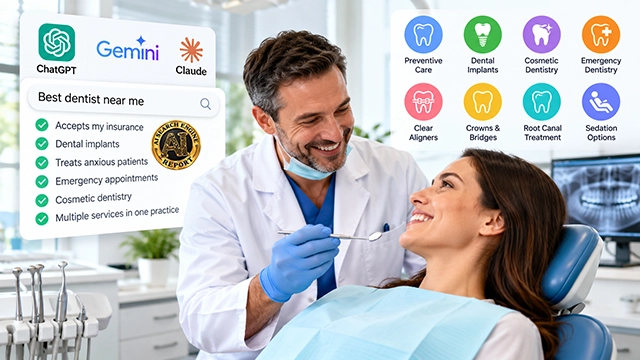
A prospective patient can ask ChatGPT, Gemini, or Claude for a dentist who accepts their insurance, offers dental implants, treats anxious patients, provides emergency appointments, performs cosmetic dentistry, or can handle several dental needs in one practice.
Before your dental practice becomes part of an answer like that, the AI system has to understand what your practice actually does.
That sounds simple. For dentists, it often is not.
A dental practice can provide preventive care, restorative dentistry, crowns, bridges, implants, dentures, root canal treatment, periodontal care, cosmetic procedures, sedation, emergency dentistry, clear aligners, and other services. Another practice may provide only some of them. Some procedures may be handled in house while others are referred to specialists.
The question is whether ChatGPT, Gemini, and Claude understand those distinctions about your practice.
My AI Search Engine Report is a manual analysis designed to answer that question. I examine how all three AI systems currently understand your dental practice, where their understanding agrees, where it differs, and what important information they may have wrong or may be missing.
What Does AI Understand About Your Dental Practice?
A patient asking an artificial intelligence search engine about dentists is rarely looking for the abstract category of dentistry.
The patient usually has a need.
Someone may need a routine examination and cleaning. Another patient may have a broken tooth and need urgent treatment. Someone may be researching dental implants. Another may want cosmetic work. A parent may be looking for a dentist who treats children. An anxious patient may specifically search for sedation options.
That creates a much more complicated AI understanding problem than simply recognizing your company as a dental practice.
ChatGPT could understand that you offer dental implants but overlook dentures. Gemini could associate the practice strongly with cosmetic dentistry while Claude describes it primarily as a general dentistry practice.
All three descriptions could contain accurate information while still presenting substantially different pictures of the same dentist.
For a practice owner, that difference is worth knowing.
AI Search Engine Report for Dentists
A dentist’s AI search visibility depends partly on whether AI systems understand the details that distinguish the practice.
I manually evaluate your business across ChatGPT, Gemini, and Claude and compare the findings.
The analysis looks beyond whether the systems recognize the practice name. It examines what they appear to understand about the practice itself.
For a dentist, that can include the types of dentistry associated with the practice, treatments and procedures, patient needs, distinguishing attributes, geographic relevance, recommendation contexts, and information that may affect whether the practice fits a particular AI search.
How I Score a Dentist’s AI Search Performance in My AI Search Engine Report
The score provides a structured way to evaluate the findings. The real value comes from seeing what is behind that score and understanding how the three AI systems reached their respective interpretations.
Does AI Know Which Dental Services You Actually Provide?
This is one of the most important questions for a dental practice.
General dentistry can encompass a broad range of care, but individual practices do not necessarily provide identical services.
Your practice might provide:
- Preventive and routine dental care
- Fillings and restorative dentistry
- Crowns and bridges
- Root canal treatment
- Dental implants
- Complete or partial dentures
- Periodontal treatment
- Extractions
- Cosmetic dentistry
- Teeth whitening
- Clear aligners or other orthodontic treatment
- Sedation dentistry
- Emergency dental care
These distinctions are not theoretical. The American Dental Association’s own terminology separates areas such as preventive dentistry, root canal therapy, implants, dentures, orthodontics and prosthodontics because they represent different forms of dental treatment.
If an AI system does not associate your practice with a service you actually provide, its understanding is incomplete.
The opposite matters too.
If an AI system associates your practice with a treatment you do not provide, a patient can receive the wrong impression.
The AI Search Engine Report looks for both types of problems.
Does AI Understand What You Handle In House and What You Refer Out?
Dentistry also has a referral dimension that makes AI understanding especially interesting.
A general dentist may perform root canals in certain cases while referring more complicated endodontic cases. A practice may restore implants but not surgically place them. Another dentist may provide clear aligners without operating a full orthodontic practice.
There are also recognized dental specialties including endodontics, orthodontics, periodontics, prosthodontics, pediatric dentistry, and oral and maxillofacial surgery.
Those boundaries matter.
A model that recognizes a dentist as offering a particular service can still misunderstand the extent of that service.
For AI searches involving specific dental needs, that difference can affect whether a recommendation makes sense.
Does AI Understand the Patients Your Practice Serves?
A dental office is not defined only by procedures.
The patient population can matter just as much.
A family dentistry practice may treat children and adults. Another general dentist may primarily serve adults. Some practices emphasize care for anxious patients. Others may have accessibility features, multilingual staff, extended hours, emergency appointments, or particular approaches to complex restorative cases.
These attributes can become important when someone asks an AI system a detailed question rather than simply searching for “dentist near me.”
For example:
“Who is a good dentist for someone afraid of dental work?”
“Which dentist near me offers implants and dentures?”
“Find a family dentist who treats adults and children.”
“Which dental practices offer emergency appointments?”
“Who offers cosmetic and general dentistry in the same practice?”
Those questions require AI to understand more than a business name and address.
They require context.
Insurance Can Change the Meaning of a Dental Recommendation
Dental insurance adds another business specific issue.
Patients commonly search for dentists based on insurance participation. Dental directories themselves allow people to search by insurance carrier and plan, demonstrating how central that information can be to choosing a dentist.
But insurance information can change.
A model could have incomplete information, outdated information, conflicting information, or no confident understanding of whether a particular plan is accepted.
That does not mean an AI system should be treated as the final authority on insurance coverage. Patients should verify coverage with the practice and their dental plan.
From the dentist’s perspective, however, there is still a useful diagnostic question:
What does AI currently believe about the insurance position of the practice?
That is exactly the kind of understanding worth examining.
Location Means More Than Knowing Your Address
Dentistry is inherently local.
Someone with severe tooth pain is probably not looking for a dentist 200 miles away. A patient choosing a dentist for recurring preventive care will normally care about convenience as well.
AI therefore needs to connect a dental practice with the correct city, community, and geographic context.
The physical address may be correct while the broader interpretation is weak.
Does AI associate the practice with the right area?
Does it understand that the practice is relevant when people ask for dentists in that location?
Does one model appear to understand the geographic relationship better than another?
Those are different questions from whether your address appears correctly on a website.
What Happens When ChatGPT, Gemini, and Claude Disagree About a Dentist?
This is one of the reasons I evaluate three systems instead of one.
There is no reason to assume ChatGPT, Gemini, and Claude have formed identical conclusions about the same dental practice.
Suppose ChatGPT associates a practice with family and restorative dentistry.
Gemini emphasizes implants and cosmetic dentistry.
Claude recognizes the practice as a general dentist but appears uncertain about its more specialized services.
Which description represents the practice accurately?
Which one is incomplete?
What information is missing?
What attributes does each system associate with the dentist?
Would the practice appear relevant to the same patient questions across all three systems?
You cannot answer those questions by testing one prompt in one AI platform.
You need to compare the patterns.
What Could a Dentist Learn From the Report?
The analysis can reveal that all three systems understand the practice reasonably well.
That is useful information.
It can also uncover missing services, incorrect associations, outdated information, weak category understanding, unclear patient use cases, different recommendation patterns, or substantial disagreements between the three models.
The purpose is not to manufacture a problem.
The purpose is to find out what is actually there.
That distinction matters because I am not selling SEO, GEO, AEO, AI visibility optimization, or an ongoing marketing service after the analysis.
I sell the diagnosis.
The report includes recommendations based on what I find, but I do not sell implementation afterward.
A $495 Look at How AI Understands Your Dental Practice
The AI Search Engine Report is a one time $495 purchase.
I personally conduct the analysis across ChatGPT, Gemini, and Claude. You receive a 10+ page PDF showing what the systems understand, misunderstand, omit, associate with the practice, and where their conclusions agree or conflict.
The report also examines recognition and recommendation visibility, provides strategic observations, and includes recommendations based on the findings.
It is delivered the next business day after the analysis is completed.
There is no automated scanner generating a score and dropping your practice into a template.
The work is manual because the important part is not merely collecting AI responses.
It is interpreting what those responses collectively say about how AI understands the business.
Do ChatGPT, Gemini, and Claude Actually Understand Your Dental Practice?
Your website can accurately describe every service you provide.
Your address can be correct.
Your insurance information can be current.
Your treatment pages can explain exactly what you do.
None of that answers the separate question of what ChatGPT, Gemini, and Claude have concluded about the practice.
They may understand it extremely well.
They may understand pieces of it.
They may disagree.
Until you look, you do not know.
That is what the AI Search Engine Report is designed to show you.
For $495, you can see what three major AI systems currently understand about your dental practice and what, if anything, deserves your attention.