
AI Search Engine Report for Truck Accident Injury Law Firms
| How I Score Truck Accident Injury Law Firms in my AI Search Engine Report | |
| Does AI understand what your business is? | 20 Points |
| Does AI understand what you actually sell or provide? | 20 Points |
| Does AI understand who your business is for? | 15 Points |
| Does AI understand what makes your business different? | 15 Points |
| Does AI know when your business belongs in the conversation? | 15 Points |
| What does AI have wrong, missing, or confused? | 10 Points |
| Do ChatGPT, Claude, and Gemini understand your business the same way? | 5 Points |
| Total points available 100 points | |
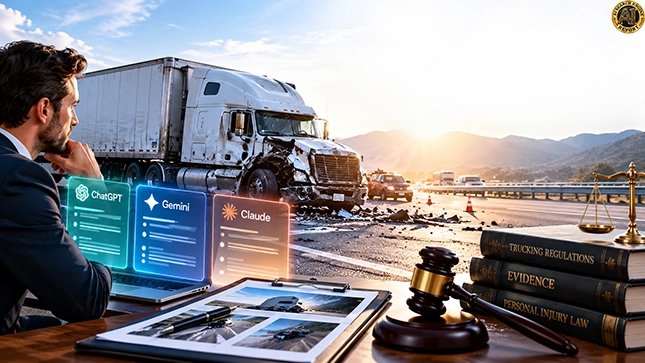
A person seriously injured in a collision with an 18 wheeler asks ChatGPT to recommend a law firm experienced in commercial trucking accidents. Another asks Gemini which attorneys handle cases involving fatigued truck drivers and federal trucking safety violations. A family dealing with a fatal tractor trailer collision asks Claude which law firms investigate trucking companies, preserve electronic evidence, and pursue wrongful death claims.
Would any of those AI systems identify your law firm? More importantly, would they understand whether your attorneys actually handle those types of cases?
The AI Search Engine Report examines what ChatGPT, Gemini, and Claude understand about your law firm, including its trucking litigation experience, legal services, geographic coverage, and potential suitability for specific client questions.
For a firm handling serious commercial truck accident claims, the distinction between being recognized as a general personal injury practice and being understood as an experienced trucking litigation firm can be significant.
What Does AI Understand About Your Truck Accident Injury Law Firm?
[Your scoring table goes here.]
A truck accident injury law firm may represent clients injured in collisions involving tractor trailers, semi trucks, commercial delivery vehicles, tanker trucks, or other large commercial vehicles. But those descriptions do not automatically establish that every firm handles the same types of claims or has the same litigation capabilities.
One firm may concentrate on catastrophic injuries and wrongful death involving interstate motor carriers. Another may handle commercial vehicle collisions as part of a broader personal injury practice. A third may have extensive experience investigating driver fatigue, negligent hiring, inadequate maintenance, and violations of federal trucking regulations.
Those distinctions matter when someone asks an AI system to recommend an attorney for a particular accident.
ChatGPT might recognize a firm’s truck accident practice but describe it only as a general automobile accident firm. Gemini might identify its commercial vehicle litigation services while overlooking its experience with complex cases involving multiple defendants. Claude might recognize the firm’s personal injury work without identifying the trucking specific capabilities that distinguish it.
The question is not simply whether an AI system knows your firm’s name. It is whether that system understands the legal work your attorneys actually perform.
Why Truck Accident Litigation Requires a Different Level of Understanding
Commercial trucking cases can involve evidence, regulations, defendants, and investigative procedures that are not typically central to an ordinary passenger vehicle accident claim.
Depending on the circumstances, a trucking collision investigation may examine driver qualification records, hours of service compliance, electronic logging device information, inspection and maintenance records, cargo loading practices, and the motor carrier’s safety procedures.
The Federal Motor Carrier Safety Administration regulates numerous aspects of commercial motor vehicle operations. Those requirements can become relevant when attorneys investigate whether driver conduct, carrier practices, or equipment conditions contributed to a collision.
Electronic logging devices are one example. They can provide information about driving time and duty status, but they are not necessarily comprehensive accident reconstruction systems. Other records or vehicle systems may be needed to examine braking, speed, or events surrounding a collision.
For a law firm with genuine experience investigating these issues, that knowledge may be an important part of its professional identity.
Yet an AI system may recognize only the broad label truck accident lawyer, without understanding whether the firm has experience with commercial motor carrier investigations, electronic evidence preservation, or litigation involving federal safety requirements.
That gap is worth identifying.
Does AI Recognize the Trucking Cases Your Firm Actually Handles?
Someone searching for a truck accident attorney may have a much more specific need than finding a lawyer who handles vehicle collisions.
Consider the differences between these situations:
A highway collision involving a tractor trailer and several passenger vehicles.
A serious injury claim involving a commercial truck driver suspected of exceeding permitted driving hours.
A collision allegedly caused by defective brakes or inadequate truck maintenance.
A fatal accident involving a motor carrier operating across state lines.
An accident involving improperly secured cargo or an overloaded commercial vehicle.
A claim involving a delivery truck owned or operated under a complicated business arrangement.
Each situation can raise different investigative questions and potentially different legal responsibilities.
A firm that regularly handles these matters may have capabilities that are not apparent from a general description of its personal injury services.
For example, an AI system might correctly identify your attorneys as handling semi truck accidents but fail to recognize their experience pursuing claims against motor carriers. It might associate your firm with trucking litigation without understanding that your practice concentrates on catastrophic injuries rather than minor vehicle damage claims.
It could also describe your firm as handling certain types of commercial vehicle cases that your attorneys do not actually accept.
An AI visibility report focused on business understanding can help identify these differences between your firm’s actual practice and how AI systems describe it.
Does AI Understand Who May Be Responsible in a Commercial Truck Accident?
Responsibility for a commercial trucking collision is not necessarily limited to the person driving the truck.
Depending on the facts and applicable law, an investigation may involve the driver’s employer, a motor carrier, a maintenance provider, a cargo loading company, or another party whose actions contributed to the collision.
Identifying potentially responsible parties requires factual investigation and legal analysis. Their involvement in a trucking operation does not automatically establish liability.
This creates another important distinction for AI recommendations.
A person asking for an attorney experienced in pursuing claims against trucking companies is expressing a different need from someone looking for general legal assistance after a minor traffic accident.
Does ChatGPT understand that your firm investigates motor carrier responsibility? Does Gemini recognize your attorneys’ experience with negligent hiring or supervision allegations? Does Claude associate your practice with complex commercial transportation litigation, or simply with vehicle accident claims?
The answers may differ across the three systems.
For firms whose experience includes complicated liability investigations, understanding how that experience is represented in AI responses can reveal meaningful omissions.
Can AI Distinguish Your Firm’s Geographic and Litigation Capabilities?
Commercial trucks routinely travel across city and state boundaries. A collision may occur in one state, involve a carrier headquartered in another, and affect injured people who live somewhere else.
For prospective clients, geography is therefore more complicated than finding the closest personal injury office.
They may want to know whether a law firm handles truck accident cases in the state where the collision occurred, whether its attorneys are licensed in the relevant jurisdiction, or whether the firm has experience with litigation involving interstate transportation.
An AI system could correctly identify your firm’s office location while misunderstanding where its attorneys practice.
It might recommend your firm for a case outside its geographic coverage. Alternatively, it might overlook your firm for an appropriate case because it associates the practice only with the city where its main office is located.
Office locations, attorney admissions, and actual case acceptance policies are not interchangeable.
The AI Search Engine Report examines whether the models understand the business’s geographic identity and relevant services, including whether their descriptions create an accurate picture of the firm.
What Happens When AI Treats Every Accident Law Firm as the Same?
Your law firm may compete for attention with practices that have very different levels of experience in commercial trucking cases.
Some firms concentrate on automobile injury claims. Others handle a broad range of personal injury litigation. Some specifically emphasize truck accident investigations and complex commercial transportation claims.
These are related legal services, but they are not identical.
A prospective client asking for an attorney who understands trucking company records, driver qualification requirements, and evidence preservation may be looking for experience beyond ordinary car accident injury representation.
If an AI system fails to recognize that distinction, its recommendations may not reflect the particular capabilities the person requested.
Your firm could be omitted from a relevant answer even when its actual experience matches the question. Conversely, it could be recommended for work that falls outside its practice.
Neither possibility should be assumed without examining actual responses.
That is why the report evaluates the same business across three AI systems instead of treating one response as a complete picture.
AI Search Engine Report for Truck Accident Injury Law Firms
The AI Search Engine Report is a manual diagnostic analysis of what ChatGPT, Gemini, and Claude understand about your law firm.
I examine how the three systems identify and describe your business, which services and attributes they associate with it, where their understanding appears accurate or incomplete, and whether they recognize the firm in relevant recommendation contexts.
For a truck accident injury law firm, that means examining issues such as recognition of commercial trucking litigation, distinctions from general automobile accident practices, the types of claims associated with the firm, and its geographic identity.
I also compare the models against one another.
One system may recognize your trucking litigation practice while another describes your firm primarily as a general personal injury office. A third may identify your attorneys’ commercial vehicle experience but associate them with the wrong geographic market.
These differences can reveal how consistently your law firm’s actual identity is understood.
The evaluation follows my published seven part scoring methodology, covering business identity, services, customers and use cases, differentiation, recommendation understanding, accuracy, and agreement between the models.
The objective is to document what the AI systems currently understand, not to promise that your firm will appear in any particular recommendation.
What Will Your Law Firm Receive?
The AI Search Engine Report is a $495 one time purchase.
You receive a PDF report of at least 10 pages containing the results of my manual evaluation of ChatGPT, Gemini, and Claude.
The report includes findings about what the systems understand correctly, what they misunderstand, what information they omit, how they recognize and describe the business, and where their responses agree or differ.
It also provides strategic observations and recommendations based on those findings.
The completed report is delivered the next business day after analysis completion.
This is not an SEO campaign, an automated AI scanner, or a service that changes what ChatGPT, Gemini, or Claude says about your firm. It does not guarantee rankings, referrals, or recommendations.
It is a diagnosis of how three major AI systems currently understand your law firm.
You can learn more about the scope of the service on the About the AI Search Engine Report page.
Does AI Understand Why Someone Should Choose Your Truck Accident Injury Law Firm?
Your attorneys may have spent years developing experience with serious trucking collisions, commercial carrier investigations, catastrophic injuries, and complex liability claims.
Your website may explain that experience in considerable detail.
But that does not establish what ChatGPT, Gemini, and Claude actually understand about your firm when someone asks for a recommendation.
One system might recognize your trucking practice. Another might overlook it. A third might identify the firm but misunderstand the cases your attorneys accept.
You do not need to guess what those systems understand.
For $495, the AI Search Engine Report provides a documented evaluation of your law firm across ChatGPT, Gemini, and Claude, showing what they recognize, what they miss, and where their understanding differs.
Order Your Truck Accident Injury Law Firm AI Search Engine Report and find out whether the three systems understand the trucking litigation experience your firm actually offers.

About Frank Masotti
Frank Masotti personally conducts every AI Search Engine Report for Truck Accident Injury Law Firms.