
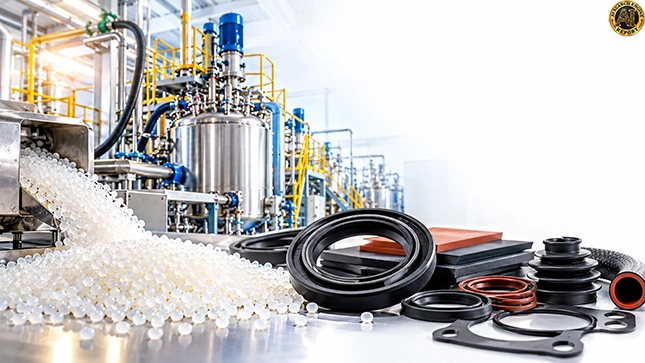
AI Search Engine Report for Acrylate Rubber Manufacturing
| How I Score Acrylate Rubber Manufacturing Businesses in my AI Search Engine Report | |
| Does AI understand what your business is? | 20 Points |
| Does AI understand what you actually sell or provide? | 20 Points |
| Does AI understand who your business is for? | 15 Points |
| Does AI understand what makes your business different? | 15 Points |
| Does AI know when your business belongs in the conversation? | 15 Points |
| What does AI have wrong, missing, or confused? | 10 Points |
| Do ChatGPT, Claude, and Gemini understand your business the same way? | 5 Points |
| Total points available 100 points | |
A manufacturer producing acrylate rubber may supply specialized elastomers for automotive seals, transmission components, industrial gaskets, or other applications requiring resistance to heat and lubricating oils. But when a potential customer asks ChatGPT, Gemini, or Claude to identify suitable manufacturers, does AI understand exactly what your company produces?
Does it recognize your particular acrylic rubber grades, manufacturing capabilities, and performance specifications? Or does it confuse your company with a supplier of finished rubber components, a manufacturer of unrelated acrylic materials, or a producer of a different synthetic elastomer?
The AI Search Engine Report examines how ChatGPT, Gemini, and Claude understand your manufacturing business. For $495, you receive a manually prepared analysis showing what these systems recognize, what they misunderstand, and whether they identify your company in relevant research and recommendation scenarios.
What Does AI Understand About Your Acrylate Rubber Manufacturing Business?
Acrylate rubber, commonly identified as ACM or polyacrylate rubber, is a specialty synthetic elastomer valued primarily for its resistance to elevated temperatures, petroleum based lubricants, oxidation, and ozone.
Manufacturers produce different formulations to meet specific application requirements. The choice of acrylate monomers, cure site chemistry, polymer composition, and processing characteristics can influence the suitability of a rubber grade for a particular product.
These differences matter when engineers, procurement departments, and industrial buyers research potential suppliers.
For example, a buyer might ask an AI system to identify manufacturers supplying ACM rubber suitable for automotive transmission seals. Another might need a high temperature grade for an underhood hose application. A third might be searching for an acrylic elastomer with particular curing characteristics or compression set performance.
All three buyers are researching acrylate rubber, but their requirements are not necessarily interchangeable.
Your company might be suitable for one application and completely unsuitable for another.
The question is whether AI recognizes those differences when describing or recommending your business.
AI Search Engine Report for Acrylate Rubber Manufacturing
An AI Search Engine Report evaluates seven areas of how major AI systems understand your company, with a total possible score of 100 points.
The analysis examines whether ChatGPT, Gemini, and Claude correctly recognize your business, understand its products, identify its intended customers, distinguish it from competitors, and associate it with appropriate purchasing and research situations.
For acrylate rubber manufacturers, this requires looking beyond a general description such as “synthetic rubber supplier.”
The analysis needs to determine whether AI understands the actual polymer products and manufacturing capabilities your company offers.
Does AI Recognize the Difference Between ACM and Other Acrylic Elastomers?
One of the most important distinctions in acrylate rubber manufacturing is the difference between ACM and AEM.
ACM is primarily based on alkyl acrylate monomers, while AEM, or ethylene acrylic elastomer, incorporates ethylene into its polymer structure.
Both materials can be used in demanding automotive applications, but their performance characteristics differ.
ACM is particularly valued for resistance to hot lubricating oils. AEM can offer advantages in low temperature flexibility and resistance to certain aqueous environments, depending on the formulation.
A manufacturer specializing in ACM should not automatically be described as producing AEM.
The same issue arises when AI compares ACM with nitrile rubber, hydrogenated nitrile rubber, or fluoroelastomers.
These materials overlap in some applications, but differences in temperature capability, fluid compatibility, physical properties, and cost affect material selection.
A potential customer researching ACM suppliers may receive an AI generated recommendation that includes manufacturers of entirely different elastomers.
The AI Search Engine Report examines whether your company is correctly associated with the materials it actually manufactures.
Does AI Understand Your Polymer Manufacturing Capabilities?
Acrylate rubber production involves more than combining ingredients to create a generic rubber material.
ACM polymers can be manufactured through processes such as emulsion or suspension polymerization. Formulations may incorporate ethyl acrylate, butyl acrylate, other acrylate monomers, and specialized cure site monomers.
These choices influence processing behavior and the properties obtainable after curing.
A manufacturer might specialize in producing base ACM polymers, supplying particular polymer grades, developing custom formulations, or providing materials intended for specific compounding and curing systems.
Other companies may purchase those polymers and manufacture finished seals, gaskets, hoses, or molded components.
Manufacturing the elastomer itself is not the same business as manufacturing products from that elastomer.
If your company supplies raw ACM polymers but does not produce finished automotive seals, AI should understand that distinction.
Similarly, if your operation includes polymer development, custom grades, or technical support for downstream compounders, those capabilities may be important to a potential customer.
The report examines whether AI recognizes what your manufacturing operation actually provides rather than assigning capabilities based on general industry associations.
Can AI Identify the Applications Your Acrylate Rubber Grades Support?
Acrylate rubber is widely used in automotive and industrial applications where heat and oil resistance are important.
Relevant applications can include:
- Engine and transmission oil seals
- Automotive gaskets and O-rings
- Transmission and other lubricant handling components
- Specialized automotive hoses
- Industrial sealing applications exposed to hot petroleum based oils
However, ACM is not appropriate for every sealing environment.
Conventional ACM formulations generally have limitations involving water, steam, hydrolysis, and low temperature flexibility. Different formulations also have different operating limits.
This becomes particularly important when AI systems attempt to recommend manufacturers based on a buyer’s operating conditions.
A manufacturer supplying conventional ACM grades should not automatically be presented as a suitable source for applications requiring prolonged exposure to hot water or extreme cold.
Conversely, a manufacturer producing specialized high temperature ACM grades may have capabilities that distinguish it from conventional suppliers.
The AI Search Engine Report investigates whether ChatGPT, Gemini, and Claude recognize the applications your products are designed to support and avoid attributing unsupported capabilities to your company.
Does AI Recognize High Temperature ACM and Specialized Grades?
Acrylic rubber technology continues to develop, particularly for demanding automotive applications.
Specialized high temperature ACM formulations can provide greater thermal endurance than conventional grades. Some manufacturers offer products designed for sustained service at temperatures approaching 175°C or higher, depending on the grade and application.
Manufacturers have also developed formulations intended to improve compression set performance, aging resistance, and flexibility across broader operating temperature ranges.
These improvements can be commercially important.
An automotive component manufacturer seeking an advanced ACM grade may be looking for performance that a conventional material cannot deliver.
If your company produces specialized grades, AI should recognize those capabilities when responding to relevant inquiries.
At the same time, it should not assume that every acrylate rubber manufacturer supplies advanced formulations.
Another emerging distinction involves raw material sourcing. Some ACM manufacturers have introduced products incorporating ethyl acrylate derived from biomass based feedstocks.
A company offering such materials may serve buyers with particular sourcing or sustainability requirements.
Whether these characteristics are recognized by AI is a question worth testing rather than assuming.
Does AI Understand Who Buys From Your Manufacturing Business?
Acrylate rubber manufacturers generally serve industrial customers rather than individual consumers.
Potential customers can include automotive component manufacturers, rubber compounders, sealing product manufacturers, industrial material distributors, and engineering organizations developing specialized elastomer components.
These customers may have very different purchasing requirements.
A rubber compounder may need a particular polymer grade with compatible curing chemistry and processing characteristics.
An automotive supplier may require materials supported by detailed performance data, consistent production quality, and applicable qualification documentation.
An industrial distributor may be more concerned with available grades, supply arrangements, and minimum order quantities.
Your manufacturing business may serve all these customer groups or only a particular segment.
The AI Search Engine Report examines whether the three AI systems correctly identify the markets and customers your company serves.
It also looks for situations where AI might recommend your company to buyers whose requirements fall outside your actual capabilities.
What Happens When AI Compares Your Company With Other Rubber Manufacturers?
A buyer researching acrylate rubber suppliers may ask ChatGPT, Gemini, or Claude to compare manufacturers.
The resulting answers might identify companies based on polymer grades, technical capabilities, geographic location, manufacturing specialization, or publicly available product information.
But those comparisons are only useful when the underlying understanding is accurate.
An AI system might recognize a large elastomer producer while overlooking a smaller manufacturer specializing in particular ACM formulations.
It might associate your company with a discontinued product, omit an important specialty grade, or confuse your manufacturing operation with a distributor carrying another company’s materials.
Different AI systems may also produce different answers to the same question.
ChatGPT might recognize your company as an ACM polymer manufacturer, while Gemini describes it more generally as a synthetic rubber supplier. Claude might identify a particular specialty but fail to associate your company with an application it actually supports.
These are possible findings, not conclusions about your company.
The purpose of the report is to test what the systems actually say.
What Will Your AI Search Engine Report Show?
Frank Masotti personally conducts the analysis across ChatGPT, Gemini, and Claude.
This is a manual investigation, not an automated website scanner or a report generated through a script.
For an acrylate rubber manufacturing business, the analysis can examine how each model understands your polymer products, manufacturing capabilities, material specialties, customer markets, and relevance to particular industrial purchasing questions.
The completed report includes:
- A review of how all three AI systems understand your company
- Identification of misunderstandings, omissions, and potentially outdated information
- Comparison of recognition and recommendation patterns
- Analysis of differences between the three models
- A scoring assessment covering seven areas
- Strategic observations and recommendations based on the findings
You receive a PDF report of at least 10 pages, delivered the next business day after the analysis is completed.
The price is a one time $495 purchase.
You can review the scoring methodology to understand how the assessment is structured.
The report does not change AI answers or guarantee that your company will be recommended. It provides evidence of how the three systems currently understand your business and identifies issues that may deserve attention.
Find Out What AI Actually Understands About Your Acrylate Rubber Manufacturing Business
Your company may manufacture highly specialized ACM polymers, offer grades designed for demanding automotive applications, or serve industrial customers with very specific material requirements.
Those capabilities matter only when a potential customer can identify your company as a relevant supplier.
Do ChatGPT, Gemini, and Claude understand what your acrylate rubber manufacturing business actually produces?
Do they recognize your specialized grades and intended applications? Do they distinguish your company from finished rubber product manufacturers and suppliers of other elastomers?
Or are important details missing from the answers potential customers receive?
The AI Search Engine Report gives you a way to find out.
For a one time price of $495, you can see how three major AI systems understand, describe, and potentially recommend your company.
Order Your AI Search Engine Report and find out what ChatGPT, Gemini, and Claude actually understand about your acrylate rubber manufacturing business.

About Frank Masotti
Frank Masotti personally conducts every AI Search Engine Report for Acrylate Rubber Manufacturing Businesses.