
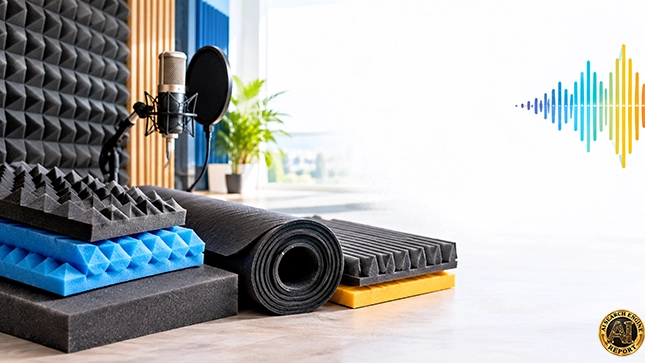
AI Search Engine Report for Acoustical Foam (i.e., Sound Barrier) Installation
| How I Score Acoustical Foam Installation business in my AI Search Engine Report | |
| Does AI understand what your business is? | 20 Points |
| Does AI understand what you actually sell or provide? | 20 Points |
| Does AI understand who your business is for? | 15 Points |
| Does AI understand what makes your business different? | 15 Points |
| Does AI know when your business belongs in the conversation? | 15 Points |
| What does AI have wrong, missing, or confused? | 10 Points |
| Do ChatGPT, Claude, and Gemini understand your business the same way? | 5 Points |
| Total points available 100 points | |
An acoustical foam installation company may specialize in controlling echoes inside recording studios, reducing noise in commercial facilities, installing sound barrier materials, or combining absorption and isolation systems. But do ChatGPT, Claude, and Gemini understand which of those services your company actually provides?
The AI Search Engine Report examines how these three AI systems understand, describe, compare, and potentially recommend your acoustical installation business.
For $495, Frank Masotti manually evaluates what the models recognize about your company, what they misunderstand, and what important information they may be leaving out.
The question is whether their understanding accurately represents the work you perform.
What Does AI Understand About Your Acoustical Foam Installation Business?
Acoustical foam installation involves more than attaching sound absorbing material to a wall. Different applications require different materials, installation methods, and performance characteristics.
A contractor installing acoustic treatment inside a recording studio serves a different customer need than a contractor installing composite sound barriers around industrial equipment.
Both may appear under similar acoustical installation terminology, but their services are not interchangeable.
When someone asks an AI system to identify a company that can reduce echoes in a conference room, isolate sound between neighboring spaces, or address equipment noise, the system needs to distinguish among these services.
A useful AI interpretation should recognize whether your company provides:
- Acoustic foam installation for reducing echoes and reverberation.
- Sound barrier installation intended to limit noise transmission.
- Composite systems combining sound absorption and sound blocking.
- Wall and ceiling acoustic treatments.
- Commercial and industrial noise control installations.
- Specialized acoustic treatment for studios, theaters, and other listening environments.
A company may offer several of these services or concentrate on one.
The distinction matters because recommending an absorption specialist for a project requiring structural sound isolation could send a customer toward the wrong service provider.
Sound Absorption and Sound Barriers Are Not the Same Service
One of the most important distinctions in acoustical installation is the difference between controlling sound reflections and preventing sound from traveling between spaces.
Conventional open cell acoustical foam absorbs sound energy and helps reduce reflections inside a room. It is commonly used where reverberation, echoes, or excessive reflected sound affect the environment.
Sound barriers address transmission. Depending on the application, they may involve mass loaded vinyl, specialized barrier composites, sealed assemblies, or other materials designed to limit sound passing through a structure or enclosure.
Some composite products combine foam absorption layers with a barrier layer to address both problems.
These differences affect which company should be considered for a particular project.
For example, a recording studio customer concerned about reflections around a microphone may need absorptive treatment. A commercial property manager concerned about conversations traveling through a shared wall may need a sound isolation solution.
An AI system that treats every acoustical foam installer as a general soundproofing contractor could misrepresent what the company actually does.
Likewise, a company capable of installing both absorption and barrier systems could be described too narrowly if AI recognizes only its foam installation services.
Why Foam Specifications and Installation Methods Matter
Not every acoustical foam product performs the same way.
Thickness, material composition, surface configuration, mounting arrangement, and frequency characteristics can affect the treatment’s performance.
Sound absorption products are commonly evaluated using measurements such as the Noise Reduction Coefficient, or NRC. Sound transmission performance may involve different measurements, including Sound Transmission Class, or STC, for appropriate assemblies.
These ratings describe different acoustic properties and should not be treated as interchangeable.
An acoustical installation contractor may also distinguish itself through experience selecting and installing materials for specific conditions.
Consider the difference between applying lightweight foam sheets to an interior wall and installing a composite barrier system around machinery. The materials, fastening requirements, surface preparation, and performance objectives may be substantially different.
Some projects use compatible construction adhesives. Others require mechanical fasteners, specialized mounting systems, or a combination of methods.
A contractor’s experience with these requirements can be an important part of its service offering.
If ChatGPT, Gemini, or Claude recognizes only the general phrase acoustic panel installation, it may overlook the technical installation capabilities that distinguish one contractor from another.
Commercial Fire Safety Is an Important Industry Distinction
Acoustical foam used on interior walls and ceilings can raise fire safety considerations, particularly in commercial and public buildings.
Applicable requirements depend on the material, its installation, the building’s occupancy, and the governing building and fire codes.
Certain products have documented fire performance under standards such as ASTM E84. However, a product’s advertised fire classification does not automatically establish that every proposed installation is permitted.
Foam plastic interior finishes can be subject to additional code restrictions.
For contractors serving commercial facilities, the ability to work with appropriately specified materials and installation requirements may be an important qualification.
A company that installs acoustical treatments in schools, offices, theaters, or industrial facilities may have experience that is not reflected by a generic description of residential foam installation.
AI systems should not automatically assume that every foam installer handles code sensitive commercial projects. They should also not overlook a contractor’s commercial capabilities when those services are genuinely part of the business.
Does AI Understand Which Customers Your Company Serves?
The acoustical installation market includes several different customer groups.
Recording studios and music production facilities may seek treatments that control reflections and improve listening conditions.
Offices and conference facilities may need improved speech clarity and reduced reverberation.
Restaurants, theaters, and other gathering spaces may require acoustic treatments suited to occupied commercial environments.
Industrial facilities may need specialized noise control materials around machinery, equipment enclosures, or production areas.
Each application creates a different reason to hire an acoustical installation contractor.
A company specializing in industrial barrier installations should not necessarily be recommended for decorative studio foam installation. Similarly, a studio treatment specialist should not automatically be represented as an industrial noise control contractor.
Geography also matters.
An acoustical contractor may serve a single metropolitan area, travel throughout a region for commercial projects, or accept specialized installations across multiple states.
If an AI model misunderstands the company’s service area, it could overlook a relevant contractor or associate the business with locations it does not serve.
The useful question is not simply whether AI knows your company exists. It is whether AI understands when your services are appropriate for the customer asking.
AI Search Engine Report for Acoustical Foam (i.e., Sound Barrier) Installation
The AI Search Engine Report examines how ChatGPT, Claude, and Gemini interpret your specific acoustical installation company.
Frank Masotti conducts the analysis manually, comparing the information and conclusions produced by each model.
The evaluation looks at whether the models correctly recognize your company’s identity, services, customers, specialties, attributes, and relevance to potential recommendations.
For an acoustical foam installation company, the analysis may reveal questions worth investigating.
Does one model identify the business primarily as a foam supplier rather than an installation contractor?
Does another recognize commercial noise control projects but overlook residential services?
Does AI associate the company with soundproofing even when its actual specialty is sound absorption?
Does it recognize specialized barrier installation capabilities?
Are its descriptions of the company’s service area and customer markets accurate?
These are examples of potential findings, not claims about any particular company’s current AI visibility.
The purpose of the report is to examine the actual responses and identify what the evidence shows.
Why Different AI Interpretations Matter
ChatGPT, Claude, and Gemini do not necessarily produce identical descriptions of the same business.
One might recognize a contractor’s recording studio work while another emphasizes commercial acoustical installations.
A third might provide a broader description that does not distinguish between sound absorption and sound isolation.
These differences can affect how a company is represented when potential customers use AI to research installation services.
The AI Search Engine Report compares the three models rather than relying on a single response.
It identifies areas of agreement, disagreement, missing information, possible inaccuracies, and interpretation differences.
The analysis also considers whether the models associate the company with appropriate customer needs and recommendation situations.
This is not a traditional search ranking audit, an automated website scan, or a service that changes AI responses.
It is a diagnostic examination of what the three AI systems currently understand about the business.
What You Receive With the AI Search Engine Report
The $495 one time purchase includes a manually prepared PDF report of more than 10 pages.
The report evaluates ChatGPT, Claude, and Gemini and provides a comparison of their understanding of your company.
Findings address business identity, services, customer needs, distinguishing attributes, recognition patterns, recommendation visibility, misunderstandings, and information omissions.
The report also includes an AI Business Understanding Score on a 100 point scale, strategic observations, and recommendations based on the findings.
Delivery is the next business day after the analysis is completed.
The objective is to give you evidence about how your business is understood, not to sell you an ongoing optimization service.
You can review the report methodology to see the seven areas used to evaluate AI business understanding.
Find Out What AI Actually Understands About Your Acoustical Installation Company
Your company may have years of experience installing acoustical foam, specialized sound barriers, or complete noise control systems.
That experience does not establish what ChatGPT, Claude, and Gemini currently understand about the business.
Do they recognize your actual installation services?
Can they distinguish your specialties from those of general acoustic product suppliers or unrelated contractors?
Do they understand the customers and projects your company is equipped to serve?
Or are important parts of your business missing, misunderstood, or described differently across the three systems?
The AI Search Engine Report is designed to answer those questions through direct manual analysis.
Order your AI Search Engine Report for $495 and find out how ChatGPT, Claude, and Gemini currently understand your acoustical foam and sound barrier installation business.

About Frank Masotti
Frank Masotti personally conducts every AI Search Engine Report for an Acoustical Foam Installation business.