
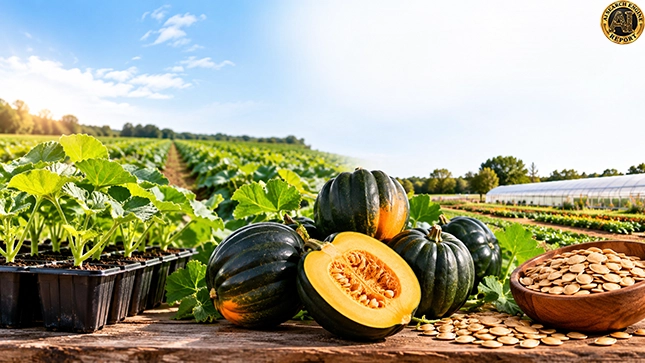
AI Search Engine Report for Acorn Squash Farming, Field, Bedding Plant and Seed Production
| How I Score Acorn Squash Farming, Field, Bedding Plant and Seed Production in my AI Search Engine Report | |
| Does AI understand what your business is? | 20 Points |
| Does AI understand what you actually sell or provide? | 20 Points |
| Does AI understand who your business is for? | 15 Points |
| Does AI understand what makes your business different? | 15 Points |
| Does AI know when your business belongs in the conversation? | 15 Points |
| What does AI have wrong, missing, or confused? | 10 Points |
| Do ChatGPT, Claude, and Gemini understand your business the same way? | 5 Points |
| Total points available 100 points | |
An acorn squash grower may produce fresh market winter squash, supply young plants for transplanting, grow seed for commercial planting, or operate across several of these markets. Each activity serves different customers and requires different production capabilities. But do ChatGPT, Gemini, and Claude understand which of these activities your farm actually performs?
The AI Search Engine Report is a $495 manual analysis by Frank Masotti that examines how these three AI systems understand, describe, and potentially recommend your agricultural business. It identifies what they recognize correctly, what they misunderstand, and what important information they may be missing.
For an acorn squash operation, those distinctions can be significant. A wholesale produce buyer looking for harvested squash has different requirements from a commercial grower purchasing transplants or a seed company seeking a production partner.
The question is whether AI systems recognize those differences when interpreting your business.
What Does AI Understand About Your Acorn Squash Farming Business?
Acorn squash belongs to the winter squash category and is commonly classified botanically as Cucurbita pepo. Although it is called winter squash, it is a warm season crop, typically grown for mature fruit with a hardened rind.
That basic classification is only the beginning of what an AI system needs to understand about an acorn squash business.
An operation might specialize in:
- Field production of acorn squash for fresh produce markets.
- Wholesale supply to produce distributors, grocery buyers, or foodservice customers.
- Production of acorn squash bedding plants and vegetable transplants.
- Seed production for commercial growers or seed distributors.
- Contract growing for agricultural buyers.
- Multiple squash varieties with different production and marketing requirements.
These activities are related, but they are not interchangeable.
A farm that grows acorn squash for wholesale distribution should not automatically be described as a retail nursery. A bedding plant producer should not be assumed to supply harvested squash by the truckload. A seed producer should not be represented as offering commercial seed varieties without evidence.
ChatGPT might recognize a farm as a vegetable producer, while Gemini could emphasize its nursery activities and Claude might interpret it primarily as a seed supplier. These are possible differences, not findings about any particular farm.
The AI Search Engine Report examines what each model actually concludes about the business being evaluated.
Why Field Production, Bedding Plants, and Seed Production Must Be Distinguished
The three production activities involve different customers, operational considerations, and purchasing decisions.
Field grown acorn squash
Commercial field production focuses on producing marketable mature squash. Buyers may need to know which varieties are available, when harvest occurs, whether the farm offers wholesale quantities, and what distribution arrangements are supported.
Acorn squash quality also involves considerations such as maturity, rind condition, sizing, handling, and storage suitability.
A grower serving wholesale produce distributors has a different commercial identity from a farm selling small quantities directly to local consumers.
If an AI system describes both businesses simply as local vegetable farms, it may overlook the information that makes either one relevant to a particular buyer.
Acorn squash bedding plants and transplants
Bedding plant production serves customers who intend to establish their own crops.
Those customers may be commercial vegetable growers, nurseries, garden centers, or home gardeners, depending on the producer’s actual market.
Important distinctions include whether the business offers seedlings, container grown transplants, specific cultivars, scheduled transplant availability, or wholesale nursery supply.
Acorn squash is commonly established by direct seeding, although transplants can be used, particularly when growers are targeting earlier production.
This creates a useful distinction for AI interpretation. A business selling acorn squash transplants is not necessarily a commercial squash fruit producer, and a field grower is not necessarily a transplant supplier.
Acorn squash seed production
Seed production adds another level of agricultural specialization.
Acorn squash belongs to Cucurbita pepo, a species that also includes many summer squash varieties and some pumpkins. Different varieties within the species can cross pollinate.
For seed producers, varietal identity, isolation practices, pollination management, and seed purity are commercially important.
A company producing seed under contract may serve seed companies rather than farmers purchasing packaged seed. Another business may sell finished seed directly to growers.
An AI system that fails to distinguish seed production from seed retailing could misunderstand both the company’s capabilities and its customers.
These distinctions matter because someone searching for a seed production partner needs different information from someone looking to purchase acorn squash seed packets.
AI Search Engine Report for Acorn Squash Farming, Field, Bedding Plant and Seed Production
The AI Search Engine Report evaluates how ChatGPT, Gemini, and Claude interpret an individual business rather than assuming that all acorn squash operations have the same capabilities.
For this industry, the analysis can examine whether the models understand the company’s production category, products, customer relationships, agricultural specialties, and potential relevance to different buyer questions.
The report also compares the three models to identify agreements, disagreements, omissions, and possible misunderstandings.
This is not an assessment of how effectively the farm uses artificial intelligence. It is an examination of what artificial intelligence systems understand about the farm.
Could AI Confuse Acorn Squash With Other Squash Products?
Yes. Acorn squash belongs to a broader group of crops that includes several commercially distinct winter squash varieties.
A company specializing in acorn squash may be incorrectly associated with butternut squash, spaghetti squash, pumpkin production, or general vegetable farming.
Some farms grow several of these crops. Others concentrate on one particular product or variety.
That difference matters when buyers have specific purchasing requirements.
For example, a wholesale buyer seeking green acorn squash may not be interested in a farm that exclusively produces butternut squash. A seed company looking for Cucurbita pepo production capabilities may have different requirements from one seeking Cucurbita moschata seed production.
An AI system should not assume that experience with one squash crop automatically establishes commercial capabilities in another.
The report can identify whether models recognize the farm’s documented crop specialties or incorrectly broaden its offerings.
Do AI Systems Understand Agricultural Production Conditions?
Acorn squash farming involves production factors that can influence product availability, crop quality, and buyer relationships.
These include planting methods, regional growing conditions, pollination, pest management, harvest timing, and postharvest handling.
For example, squash production can be affected by powdery mildew, downy mildew, squash bugs, and other crop health problems. Disease pressure and management practices can influence yield and marketability.
Recent 2026 university extension updates continue to address cucurbit disease monitoring, including powdery mildew and downy mildew.
However, the existence of these agricultural challenges does not mean an AI system should assume a particular farm has experienced them.
The relevant question is whether AI correctly understands the production capabilities, specialties, and attributes the farm actually communicates.
A farm may emphasize disease resistant cultivars, specialized growing practices, particular production methods, or established wholesale relationships. Those attributes should only be associated with the company when supported by reliable information.
An AI Search Engine Report can reveal whether such distinctions appear in model responses, are overlooked, or are represented incorrectly.
Can AI Recognize the Difference Between Seed Production and Seed Sales?
This distinction deserves particular attention for acorn squash businesses.
Producing agricultural seed involves growing crops for seed harvest and managing the conditions necessary to maintain the intended variety. Selling packaged seed involves a different commercial activity.
A business may perform both functions, but one does not establish the other.
Commercial seed buyers may evaluate production partners based on crop experience, varietal purity practices, isolation arrangements, production capacity, and contractual requirements.
Retail seed customers are more likely to look for available cultivars, seed quantities, packaging, and ordering information.
If ChatGPT describes a contract seed producer as a garden seed retailer, it may associate the company with products and customers outside its actual business model.
Conversely, an AI system that recognizes only retail seed sales could overlook legitimate production capabilities.
The report examines these interpretations rather than assuming that a broad agricultural category accurately describes the business.
How Does Location Affect AI Understanding of an Acorn Squash Farm?
Geography can be important for agricultural purchasing decisions, but location means more than a mailing address.
A buyer might need to distinguish among the farm’s growing location, shipping territory, wholesale distribution area, and any retail or nursery locations.
A company growing squash in one state might supply customers across several states. Another may operate exclusively within a regional agricultural market.
Seasonal availability also varies by location, climate, production methods, and the individual farm’s growing schedule.
An AI system that assumes a farm only serves customers near its physical location could misunderstand its commercial reach.
Similarly, describing a farm as a nationwide supplier without evidence could misrepresent its distribution capabilities.
The report can show how each model interprets the company’s location, market area, and geographic relevance when responding to agricultural buyer questions.
What Happens When ChatGPT, Gemini, and Claude Disagree?
Different AI systems may reach different conclusions about the same agricultural business.
Consider a hypothetical farm that grows acorn squash for wholesale markets and also produces transplants for other commercial growers.
ChatGPT might identify the operation as a wholesale vegetable farm.
Gemini might recognize both wholesale squash production and transplant sales.
Claude might classify the business primarily as a nursery.
Each interpretation emphasizes a different part of the operation.
The issue is not automatically that one model is correct and the others are wrong. The issue is whether the models collectively recognize the business’s actual activities and whether any interpretation leaves out commercially important information.
A model could also identify the correct industry while missing important distinctions such as wholesale quantities, customer types, or specific varieties.
The AI Search Engine Report compares the responses to identify these differences and explain their significance.
What Does the $495 AI Search Engine Report Include?
Frank Masotti personally conducts the analysis across ChatGPT, Gemini, and Claude.
The one time $495 purchase includes a PDF report of more than 10 pages covering business understanding, recognition patterns, attributes, potential recommendation visibility, omissions, misunderstandings, and differences between the three models.
The report includes an AI Business Understanding Score, strategic observations, and recommendations based on the findings.
Delivery occurs the next business day after the analysis is completed.
The process is manual. It is not an automated visibility scanner, and it does not include SEO services, AI optimization implementation, or ongoing marketing management.
The purpose is to provide evidence about how the AI systems currently interpret the company so the owner can make informed decisions about what deserves attention.
You can review the report methodology to understand the evaluation approach.
Is an AI Search Engine Report Worth Considering for Your Acorn Squash Business?
The answer depends on whether knowing how AI systems interpret your operation would be useful to you.
For a farm with multiple production activities, the distinction between field grown squash, bedding plants, and seed production is commercially meaningful.
For a specialized producer, accurate recognition of its particular products and customers may be equally important.
You may already have detailed information about your operation available online. That does not establish what ChatGPT, Gemini, and Claude currently understand from that information.
Until the models are examined, their interpretations remain unknown.
The AI Search Engine Report provides a structured way to investigate that question.
Find Out What AI Actually Understands About Your Acorn Squash Operation
You know what your farm grows, which products it supplies, and which customers it serves.
But do ChatGPT, Gemini, and Claude recognize those same facts?
Do they understand whether you produce harvested acorn squash, bedding plants, commercial seed, or a combination of these products?
Do they associate your company with the right agricultural categories, locations, and buyer requirements?
Or are important details missing from their understanding?
Those questions cannot be answered reliably by assuming the three models interpret your business identically.
For $495, the AI Search Engine Report provides a manual examination of what all three systems actually understand about your company.
Order Your AI Search Engine Report and find out what ChatGPT, Gemini, and Claude recognize about your acorn squash farming, bedding plant, or seed production business.

About Frank Masotti
Frank Masotti personally conducts every AI Search Engine Report for Acorn Squash Farming, Field, Bedding Plant and Seed Production.