
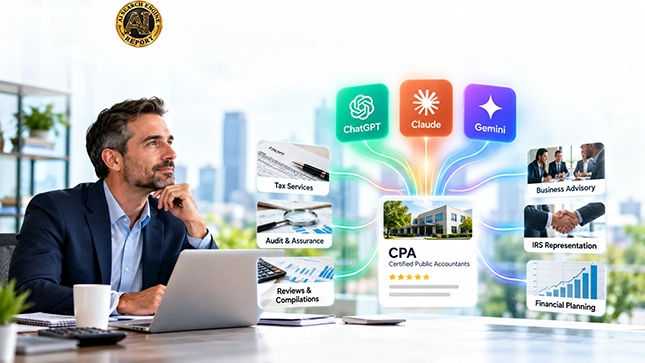
AI Search Engine Report for Accountants’ Certified Public
| How I Score (CPA’s) Accountants’ Certified Public in my AI Search Engine Report | |
| Does AI understand what your business is? | 20 Points |
| Does AI understand what you actually sell or provide? | 20 Points |
| Does AI understand who your business is for? | 15 Points |
| Does AI understand what makes your business different? | 15 Points |
| Does AI know when your business belongs in the conversation? | 15 Points |
| What does AI have wrong, missing, or confused? | 10 Points |
| Do ChatGPT, Claude, and Gemini understand your business the same way? | 5 Points |
| Total points available 100 points | |
A certified public accounting firm may hold the professional qualifications to provide specialized tax services, financial statement audits, reviews, compilations, or business advisory services. But does ChatGPT, Claude, or Gemini understand which of those services your particular CPA practice actually provides?
A prospective client looking for a CPA to perform an independent financial statement audit has a different need from someone seeking IRS representation, partnership tax planning, or outsourced financial management. Recognizing your firm’s name and CPA designation does not establish that an AI system understands those differences.
My AI Search Engine Report manually examines how ChatGPT, Claude, and Gemini understand your CPA practice, including its services, professional identity, specialties, client focus, and potential relevance to recommendations.
For $495, you can find out what those three AI systems understand about your firm, what they misunderstand, and what important information they may be missing.
What Does AI Understand About Your Certified Public Accounting Practice?
A CPA license establishes a professional qualification. It does not mean every certified public accountant performs every kind of accounting engagement.
Some CPA firms specialize in business and individual taxation. Others concentrate on audit and assurance services, financial reporting, forensic accounting, business valuation, or client advisory services.
A firm may combine several specialties while deliberately excluding others.
Consider someone asking ChatGPT:
“Which CPA firms can perform an independent audit for our nonprofit organization?”
For a useful recommendation, the system needs to recognize more than the CPA designation. It must understand whether the firm actually performs financial statement audits, has relevant nonprofit experience, and meets the professional requirements applicable to the engagement.
Now consider a different request:
“I need a CPA experienced in partnership taxation and IRS representation.”
That request involves a different combination of professional services.
Your firm might be an excellent choice for one engagement and unsuitable for the other.
The question is whether AI systems understand those distinctions or simply associate your practice with the broad category of certified public accountants.
AI Search Engine Report for Accountants’ Certified Public
The AI Search Engine Report examines how ChatGPT, Claude, and Gemini interpret your CPA practice when identifying, describing, comparing, and potentially recommending accounting businesses.
It is not an audit of your firm’s internal use of artificial intelligence. It is not an automated SEO scanner or a service that changes AI responses.
I personally evaluate your practice across all three models and compare what they understand.
The analysis looks at your firm’s professional identity, services, client types, distinguishing attributes, recognition patterns, recommendation visibility, accuracy, and differences between the models.
The findings are evaluated using my AI Search Engine Report methodology, which measures seven dimensions of business understanding and produces an overall score out of 100.
For a CPA practice, professional service distinctions are especially important because a broad accounting description can be technically correct while still being inadequate for a client’s actual needs.
Does AI Distinguish CPA Licensure From Tax Preparation Credentials?
Not every accountant is a CPA, and not every person authorized to prepare tax returns holds a CPA license.
The IRS distinguishes between tax professionals based on their credentials and representation rights.
Certified public accountants, enrolled agents, and attorneys have unlimited representation rights before the IRS, subject to applicable professional requirements. Other tax return preparers may have limited representation rights or none.
This distinction matters when someone asks an AI system for professional help with an IRS examination, appeal, or collection matter.
However, having the professional authority to represent taxpayers does not establish that every CPA firm offers tax controversy services.
A CPA practice specializing in financial statement audits may have no interest in accepting IRS representation engagements.
A firm focused on tax controversy may have extensive experience with examinations and appeals but offer no audit services.
An AI system could misunderstand the practice in either direction.
It might overlook a firm’s genuine tax representation services or incorrectly assume that a CPA designation means those services are available.
For a certified public accounting practice, accurate professional identity requires understanding both qualifications and the services actually offered.
Can AI Tell the Difference Between Audits, Reviews, Compilations, and Financial Statement Preparation?
These are distinct professional services, not interchangeable descriptions of accounting work.
An audit provides reasonable assurance through procedures supporting an auditor’s opinion on financial statements.
A review provides limited assurance, generally involving inquiry and analytical procedures.
A compilation assists management in presenting financial statements without providing assurance.
Financial statement preparation is another distinct service that does not itself provide assurance.
A prospective client may need a particular engagement because of a loan agreement, investor requirement, contractual obligation, regulatory responsibility, or governance requirement.
A CPA firm that prepares financial statements does not automatically offer independent audits.
Likewise, a firm specializing in assurance engagements should not be understood only as a tax preparation provider.
This creates a specific AI understanding problem.
If someone asks Gemini for a CPA firm that performs reviews of privately held companies, does it recognize your firm’s review services?
If someone asks Claude for an independent financial statement auditor, does it understand whether your practice actually offers that engagement?
If ChatGPT describes your firm as providing general accounting services, does that description omit a significant assurance specialty?
Those are the kinds of distinctions that a manual evaluation can examine.
Why the 2026 Quality Management Standards Matter to CPA Firm Descriptions
Accounting and auditing practices entered 2026 operating under significant changes to the AICPA’s quality management framework.
The new quality management standards required applicable firms to design and implement their systems of quality management by December 15, 2025.
During 2026, affected practices have been operating those systems, monitoring their effectiveness, and addressing identified deficiencies.
The AICPA also released updated peer review guidance in August 2026 to help firms prepare for reviews under the new quality management standards.
These developments are relevant to how CPA firms describe their professional practices.
A firm performing assurance engagements has different professional responsibilities from a practice limited to tax preparation.
An AI system should not assume that every CPA practice operates under identical engagement requirements, provides identical services, or participates in the same professional review activities.
For firms whose assurance capabilities are an important part of their identity, a useful diagnostic question is whether AI recognizes those capabilities accurately.
The AI Search Engine Report does not evaluate a firm’s compliance with professional standards. It examines what the AI models understand about the firm’s business and services.
Does AI Understand Your CPA Firm’s Client Advisory Services?
Client advisory services, often called CAS, can involve much more than traditional bookkeeping.
Depending on the practice, these services may include monthly financial reporting, outsourced controller functions, cash flow analysis, budgeting, financial management advice, and outsourced CFO support.
A CPA firm offering these services may help clients interpret financial information and make business decisions rather than simply recording transactions.
That distinction becomes particularly relevant with Statement on Standards for Accounting and Review Services No. 27.
Issued in 2025, SSARS No. 27 clarifies when financial statements prepared as part of a consulting services engagement fall outside the requirements of AR-C Section 70.
The standard is effective for financial statements prepared for periods ending on or after December 15, 2026, with early implementation permitted.
The distinction matters because financial statements produced as part of a consulting engagement do not automatically represent the same service as a separate financial statement preparation engagement.
For AI interpretation, the issue is whether a model understands the actual nature of your firm’s services.
A CPA practice providing outsourced CFO advice should not automatically be characterized as a financial statement audit provider.
Likewise, describing an established advisory practice as merely a bookkeeping service may overlook the work that distinguishes it from other accounting businesses.
Your firm may know precisely how its advisory engagements are structured.
But does ChatGPT, Claude, or Gemini understand that structure well enough to describe the business correctly?
Does AI Recognize Your CPA Firm’s Industry Specializations?
CPA practices frequently develop expertise serving particular industries.
A firm specializing in construction accounting may understand contract revenue recognition, job costing, work in progress schedules, and contractor financial reporting.
A practice serving nonprofit organizations may have experience with restricted contributions, nonprofit financial statements, Form 990 reporting, and the reporting responsibilities of tax exempt organizations.
A CPA firm serving medical practices may specialize in physician compensation arrangements, practice financial management, and tax considerations affecting healthcare businesses.
Other practices may concentrate on real estate partnerships, professional service companies, manufacturers, closely held corporations, or high net worth individuals.
These are not interchangeable specialties.
When a construction company asks an AI system for a CPA familiar with contractor financial reporting, a generic description of your firm as an accounting practice may not communicate its actual qualifications or experience.
The same issue arises when a nonprofit seeks an audit firm with relevant sector expertise.
An AI Search Engine Report can examine whether the models associate your practice with the industries you serve and whether those specialties appear when the models consider relevant business recommendations.
Can AI Distinguish a CPA Firm’s Service Area From Its Office Location?
CPA practices do not always serve clients exclusively in the city where their offices are located.
Some firms operate locally. Others serve clients across several states or provide remote tax and advisory services.
Professional licensing, firm registration, mobility rules, and the nature of particular engagements can affect where certain services may be provided.
An AI system should not automatically assume that a CPA firm can perform every regulated professional service nationwide simply because it offers virtual appointments.
It should also avoid treating an office address as the entire geographic market served by a practice.
For example, a firm may maintain one physical office while accepting tax advisory clients across multiple states.
Another practice may offer local assurance engagements but provide certain consulting services remotely.
If AI understands only the office address, it may overlook part of the firm’s actual service area.
If it assumes unrestricted nationwide availability, it may overstate the firm’s professional reach.
The correct interpretation depends on the individual practice.
What Happens When AI Uses Outdated Information About Your CPA Firm?
Certified public accounting practices change over time.
Partners retire. Firms merge. Offices relocate. Client acceptance policies change. Practices expand into advisory services or discontinue certain engagements.
Professional credentials and firm authorizations also require current information.
A CPA firm that previously performed financial statement audits may now focus entirely on taxation.
Another practice may have expanded into nonprofit assurance engagements or specialized business valuation services.
If an AI system relies on an outdated understanding of the firm, it could associate the practice with services it no longer offers or overlook capabilities it has developed.
The AI Search Engine Report examines whether the models produce information that appears outdated, incomplete, or inconsistent with the actual business.
The report does not replace verification through state accountancy boards or other authoritative professional sources. Its purpose is to identify what the AI systems themselves understand and communicate.
What If ChatGPT, Claude, and Gemini Understand Your CPA Firm Differently?
The three models do not necessarily form identical interpretations of a business.
Consider a hypothetical CPA firm specializing in partnership taxation, nonprofit audits, and outsourced financial management.
ChatGPT might recognize its tax services but provide little information about its nonprofit audit practice.
Claude might identify the firm’s assurance capabilities while overlooking its outsourced financial management services.
Gemini might recognize its industry specializations but associate the firm with an outdated office location.
These are illustrative possibilities, not actual findings about any particular CPA firm.
The report establishes what the models actually return during the evaluation.
For a CPA practice, disagreement can be particularly meaningful when the models associate the firm with different professional services.
If one model understands the practice as a tax specialist and another sees it as an audit firm, the difference deserves examination.
The issue is not simply which model provides the longest description.
It is which model correctly understands the firm’s identity, services, qualifications, clients, and distinguishing characteristics.
Does AI Know When Your CPA Firm Belongs in a Recommendation?
Recognizing a CPA firm’s name is different from understanding when the practice is relevant to a prospective client’s request.
Someone might ask:
“Which CPA firms perform financial statement audits for nonprofit organizations?”
Another might ask:
“Who can help my partnership with complex federal and state tax matters?”
A third might ask:
“Can you recommend a CPA firm that provides outsourced controller services for growing businesses?”
Each request involves a different combination of professional services, experience, and client needs.
A useful recommendation requires the AI system to understand enough about the practice to recognize whether it belongs in that particular conversation.
The AI Search Engine Report examines recognition and recommendation visibility alongside the models’ understanding of your services.
It can reveal whether the models recognize relevant capabilities, overlook important specialties, or associate the practice with services it does not provide.
It does not guarantee future recommendations or changes to AI search results.
The value is knowing what the systems currently understand.
What Does the $495 AI Search Engine Report Include?
The AI Search Engine Report is a one time purchase of $495.
I personally conduct the analysis across ChatGPT, Claude, and Gemini. The completed report includes:
- A PDF report of 10 or more pages.
- Manual evaluation of all three AI models.
- An AI Business Understanding Score out of 100.
- Comparisons of the models’ understanding of your practice.
- Findings about professional identity, services, specialties, and business attributes.
- Examination of recognition and recommendation visibility.
- Identification of misunderstandings, omissions, and potentially outdated information.
- Strategic observations and recommendations based on the findings.
The completed report is delivered the next business day after analysis completion.
There is no required subscription, automated monitoring service, or ongoing marketing retainer.
The report does not implement SEO changes, alter AI responses, or guarantee recommendations.
It provides a documented diagnosis of how the three AI systems understand your CPA practice.
For a broader look at accounting businesses, you can also read my AI Search Engine Report for Accountants and AI Search Engine Report for Accountants’ Private Practices.
Do ChatGPT, Claude, and Gemini Understand Your CPA Practice Correctly?
You know whether your firm specializes in taxation, audits, reviews, compilations, advisory services, forensic accounting, or another area of certified public accounting.
You know which clients you accept, which industries you serve, and which professional services your practice is qualified and prepared to provide.
But do ChatGPT, Claude, and Gemini understand those same distinctions?
Do they recognize your firm’s actual specialties?
Do they distinguish your CPA practice from general bookkeeping and tax preparation businesses?
Do they understand when your firm is a relevant option for someone seeking a particular professional engagement?
And do all three models reach the same conclusions?
Those questions cannot be answered by assuming that your website or professional credentials tell the complete story.
For $495, you can order your AI Search Engine Report and receive a manual analysis showing what ChatGPT, Claude, and Gemini understand about your certified public accounting practice.
Find out what AI actually understands about your firm.

About Frank Masotti
Frank Masotti personally conducts every AI Search Engine Report for businesses involved in (CPA’s) Accountants’ Certified Public.