
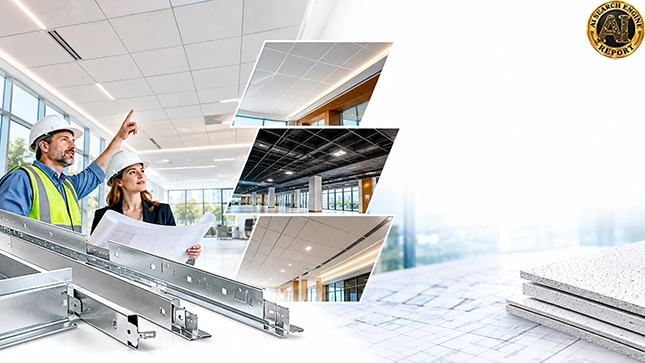
AI Search Engine Report for Acoustical Suspension Systems, Metal, Manufacturing
A company manufacturing metal acoustical ceiling suspension systems may produce precision engineered ceiling grids, main runners, cross tees, perimeter components, and specialized suspension products for commercial construction.
But does ChatGPT, Gemini, or Claude understand which of those products your company actually manufactures?
If an architect asks AI to identify manufacturers of heavy duty acoustical ceiling suspension systems, will your company be recognized for its relevant products? Or will the AI system describe your business as a general metal fabrication company without identifying its ceiling suspension specialties?
The AI Search Engine Report examines how ChatGPT, Claude, and Gemini understand your metal acoustical suspension system manufacturing business. It identifies what the models recognize, what they misunderstand, and which important capabilities may be missing from their descriptions.
For $495, you can find out whether three major AI systems accurately understand the products your company manufactures and the customers those products serve.
What Does AI Understand About Your Metal Acoustical Suspension System Manufacturing Business?
Manufacturing metal acoustical suspension systems involves producing the structural components that support suspended acoustical ceiling panels.
These components are not necessarily interchangeable.
A manufacturer may produce conventional exposed ceiling grids for commercial offices, concealed suspension systems for architectural applications, or specialized components designed for particular ceiling configurations.
Some manufacturers produce complete suspension systems. Others concentrate on specific components, proprietary connection systems, or custom metal profiles.
The differences matter when architects, ceiling contractors, distributors, and construction companies research manufacturers.
Consider a commercial construction project requiring a heavy duty ceiling suspension system with documented structural performance.
That requirement is different from a renovation project where the contractor needs replacement cross tees compatible with an existing ceiling grid.
It is also different from an architectural project requiring a concealed suspension system with a particular ceiling appearance.
An accurate AI description should distinguish these manufacturing capabilities rather than assuming every acoustical suspension system manufacturer produces the same products.
The central question is whether ChatGPT, Gemini, and Claude recognize your actual product lines, technical capabilities, customer markets, and manufacturing specialties.
AI Search Engine Report for Acoustical Suspension Systems, Metal, Manufacturing
One of the most important questions for a metal acoustical suspension system manufacturer is whether AI understands the difference between producing ceiling suspension components and providing other ceiling related products or services.
A customer might ask ChatGPT to identify manufacturers of galvanized steel ceiling grid systems.
Another might ask Gemini to find companies manufacturing concealed metal suspension systems for architectural ceilings.
A building products distributor might use Claude to research manufacturers supplying heavy duty main runners and compatible cross tees.
These requests involve different products and purchasing requirements.
A company specializing in standard exposed ceiling grids should not automatically be described as a manufacturer of every type of architectural suspension system.
Likewise, a manufacturer with documented capabilities in specialized metal ceiling suspension components should not be reduced to a generic sheet metal fabrication company.
The AI Search Engine Report examines whether the models recognize these distinctions and associate your business with the appropriate products and manufacturing capabilities.
Does AI Understand the Difference Between Ceiling Suspension Manufacturing and Ceiling Installation?
Manufacturing and installing metal acoustical ceiling suspension systems are separate business activities.
A manufacturer produces the components that make up the suspension system. Depending on its operations, that may include forming steel profiles, producing interlocking connections, applying protective finishes, and testing components for specified performance requirements.
An installation contractor assembles and secures the suspension system within a building.
The distinction is reflected in the industry’s technical standards.
ASTM C635/C635M addresses the manufacture, performance, and testing of metal suspension systems for acoustical tile and lay in panel ceilings.
ASTM C636/C636M addresses installation practices for those systems.
These standards concern related products and activities, but they serve different purposes.
Could AI mistake your manufacturing company for a ceiling contractor?
Yes. An AI system could potentially associate a manufacturer of acoustical ceiling grid components with ceiling installation services that the company does not provide.
For example, a manufacturer supplying suspension components through building material distributors should not automatically be described as a contractor installing suspended ceilings in commercial buildings.
Similarly, a manufacturer that provides engineering assistance or technical product guidance should not be assumed to offer installation services.
If AI confuses manufacturing with installation, it may misunderstand the company’s customers, capabilities, and role in the construction supply chain.
The report examines whether ChatGPT, Claude, and Gemini accurately identify what your company manufactures and how its products reach the market.
Why Structural Load Classifications Matter to Metal Suspension System Manufacturers
Metal acoustical ceiling suspension systems must support the loads for which they are designed and specified.
ASTM C635/C635M establishes three structural classifications for ceiling suspension systems:
Light duty
Intermediate duty
Heavy duty
These classifications are based on the load carrying capacity of the main runners under specified testing conditions.
They are not simply marketing descriptions.
A manufacturer producing heavy duty suspension systems may serve projects with requirements that differ from those using intermediate duty or light duty systems.
A buyer researching products for a particular construction project may need to know which classifications a manufacturer actually offers.
Does AI recognize your company’s documented load classifications?
Suppose your company manufactures intermediate duty and heavy duty ceiling suspension systems but does not produce light duty products.
An AI system that describes the company only as a ceiling grid manufacturer may omit an important product distinction.
Another model might incorrectly associate the company with a load classification unsupported by its product specifications.
Neither interpretation provides a complete picture.
The AI Search Engine Report examines whether the models recognize documented product classifications and whether those classifications are represented accurately.
Exposed and Concealed Suspension Systems Are Different Product Categories
Metal ceiling suspension systems can differ substantially in their visible appearance and component design.
Exposed grid systems leave portions of the suspension structure visible after ceiling panels are installed.
Concealed systems use configurations that hide or minimize the appearance of supporting components.
Manufacturers may offer standard exposed grid profiles, narrow face systems, architectural reveal designs, concealed tee arrangements, or specialized suspension configurations.
Even within exposed systems, profile dimensions can differ.
For example, 15/16 inch and 9/16 inch exposed grid systems are established product configurations used in commercial ceiling applications.
These differences affect ceiling appearance, panel compatibility, and project specifications.
A manufacturer producing standard exposed grids should not automatically be represented as a supplier of concealed architectural suspension systems.
Likewise, a company specializing in concealed or decorative suspension components may have important capabilities that a generic description of metal ceiling grids fails to capture.
For architects and distributors researching particular products, those distinctions can be relevant to manufacturer selection.
Can AI Distinguish Metal Suspension Components From Acoustical Ceiling Panels?
A metal acoustical suspension system manufacturer does not necessarily manufacture the ceiling panels supported by its products.
Suspension components and acoustical panels perform different functions within a completed ceiling assembly.
The metal suspension system provides the supporting framework.
The acoustical panels may provide sound absorption, contribute to sound attenuation, or satisfy other specified architectural and building performance requirements.
Some companies manufacture both suspension systems and ceiling panels. Others manufacture only one category.
A business producing galvanized steel main runners, cross tees, and perimeter moldings should not automatically be described as a manufacturer of mineral fiber or fiberglass acoustical panels.
Similarly, a ceiling panel manufacturer should not be assumed to manufacture the metal suspension components used with its products.
Why does this distinction matter for AI recommendations?
Consider a building products distributor looking for a manufacturer that can supply metal ceiling suspension components.
If AI identifies companies that manufacture only acoustical ceiling panels, the recommendation may not satisfy the distributor’s purchasing requirements.
A different problem occurs when a suspension system manufacturer also produces specialty architectural components, but AI recognizes only its standard ceiling grid products.
In both situations, the AI system may understand the general industry while missing important product distinctions.
The report examines whether the three models correctly identify your company’s actual manufacturing activities.
Does AI Understand Seismic Requirements for Ceiling Suspension Systems?
Certain construction projects require ceiling suspension systems and installation details that address earthquake related movement.
ASTM E580/E580M covers installation practices for suspended acoustical ceiling systems in areas subject to specified seismic conditions.
The standard distinguishes between Seismic Design Category C and the more demanding categories D, E, and F.
For manufacturers, seismic applications can involve product characteristics such as connection performance, component compatibility, and approved suspension configurations.
However, a manufacturer’s product should not be described as universally compliant with seismic requirements simply because it is a metal ceiling suspension system.
The suitability of a particular assembly depends on its documented characteristics, the applicable building requirements, and the approved installation details.
Could AI incorrectly describe your products as suitable for seismic applications?
An AI system might associate a manufacturer’s standard ceiling grid with seismic applications without identifying the specific products or configurations that have documented qualifications.
Alternatively, it might overlook a manufacturer’s specialized seismic suspension components and describe the company only as a supplier of conventional ceiling grids.
Both possibilities matter when architects and contractors are researching products for projects with defined seismic requirements.
The AI Search Engine Report evaluates whether the models accurately recognize the manufacturer’s documented product capabilities without inventing technical qualifications.
Corrosion Resistance and Material Finishes Can Distinguish Manufacturers
Metal acoustical suspension systems are commonly manufactured using formed steel components with protective coatings or finishes.
However, different environments can require different material characteristics.
A standard interior office ceiling may have different exposure conditions from a high humidity facility or an exterior ceiling application.
Manufacturers may offer different galvanized steel coating specifications, corrosion resistant products, or specialty finishes.
For example, products using G90 galvanized steel coatings are available for applications where increased corrosion resistance is desirable.
That does not mean every suspension system made from galvanized steel is suitable for every humid or exterior environment.
Product suitability depends on the manufacturer’s specifications and the conditions of the project.
Does AI recognize your company’s material and coating specialties?
Suppose your company manufactures suspension components intended for demanding humidity conditions.
If ChatGPT describes the company only as a general ceiling grid supplier, it may overlook a relevant manufacturing specialty.
Gemini might recognize the company’s corrosion resistant products but incorrectly assume every product in its catalog has the same characteristics.
Claude might identify its galvanized steel suspension systems without recognizing the environments for which particular products are designed.
These are hypothetical examples, not findings about any specific manufacturer.
The report examines whether the models associate your company with its actual product characteristics and documented applications.
Why Component Compatibility Matters to Manufacturers
Ceiling suspension components are not automatically interchangeable between different manufacturers or product families.
A suspension system may include main runners, cross tees, perimeter moldings, connection details, and accessories designed to function together.
Connection geometry, profile dimensions, locking mechanisms, and approved assembly requirements can affect compatibility.
This becomes particularly important when contractors need replacement components for an existing ceiling system.
A distributor might ask AI to identify manufacturers of compatible replacement grid components.
A contractor might research a manufacturer that produces a particular suspension profile or connection design.
If AI treats all metal ceiling grid components as interchangeable, it may provide an incomplete or misleading understanding of the available products.
A manufacturer with proprietary connection systems or specialized component compatibility may have distinctions worth recognizing.
The AI Search Engine Report examines whether those documented differences appear in the models’ understanding of the company.
How Manufacturers Can Be Misunderstood Within the Construction Supply Chain
Metal acoustical suspension system manufacturers may serve several types of customers.
Some sell primarily through building material distributors.
Others supply ceiling contractors, architectural product dealers, or commercial construction projects through established distribution relationships.
A manufacturer may also provide technical documentation, product submittals, installation guidance, or specification support.
These activities do not necessarily mean the company sells directly to individual property owners or provides construction services.
Consider three hypothetical manufacturers.
The first produces conventional exposed ceiling grid systems distributed nationally through building material suppliers.
The second specializes in architectural suspension components for commercial projects with particular design requirements.
The third manufactures replacement and specialty suspension components for a narrower product market.
All three belong within metal acoustical suspension system manufacturing.
But their products, customers, and commercial relationships differ.
If a distributor asks AI about manufacturers supplying standard ceiling grid components, the first company may be relevant.
If an architect needs a specialized concealed suspension profile, the second may be more appropriate.
If a contractor is trying to locate a particular replacement component, the third may be the relevant manufacturer.
The issue is not which manufacturer is universally better.
The issue is whether ChatGPT, Gemini, and Claude understand which companies belong in which purchasing conversations.
Why ChatGPT, Gemini, and Claude May Describe the Same Manufacturer Differently
Three AI systems can reach different conclusions about the same manufacturing company.
For example, ChatGPT might identify a business as a manufacturer of commercial metal ceiling suspension systems.
Gemini might describe the same company as a general architectural metal products manufacturer without identifying its acoustical ceiling grid products.
Claude might recognize the company’s suspension systems but associate it primarily with ceiling installation rather than manufacturing.
These examples illustrate possible differences, not actual findings about a particular company.
One model might recognize the manufacturer’s heavy duty suspension products while another overlooks those classifications.
Another might associate the company with ceiling panels it does not manufacture.
A model could also misunderstand its geographic markets, distribution relationships, or specialized product offerings.
Frank Masotti manually compares the responses from ChatGPT, Claude, and Gemini to identify agreements, disagreements, missing information, and potentially inaccurate conclusions.
The AI Search Engine Report methodology explains how these findings contribute to the 100 point AI Business Understanding Score.
What Can a Metal Acoustical Suspension System Manufacturer Learn From the Report?
The analysis can help establish whether AI accurately understands your company’s manufacturing identity, product lines, technical specialties, customer markets, and geographic coverage.
It may reveal that the models recognize your standard ceiling grid products but overlook your concealed suspension systems.
It could show that one model understands your heavy duty product classifications while another describes your products without distinguishing their structural capabilities.
The findings might reveal confusion between your manufacturing operations and the activities of ceiling installation contractors.
Another possible finding is that all three models consistently recognize your products, customer markets, and manufacturing specialties.
The report does not assume something is wrong.
Its purpose is to determine what the evidence actually shows.
That gives you a documented basis for understanding how three major AI systems currently represent your manufacturing business.
What Is Included in the $495 AI Search Engine Report?
The AI Search Engine Report is a manual business analysis conducted by Frank Masotti.
Your company is evaluated across ChatGPT, Claude, and Gemini using 15 diagnostic questions, producing 45 raw responses for examination.
The completed report includes:
A PDF report of 10 or more pages.
An evaluation of how the models understand your business identity, manufacturing capabilities, products, and customer applications.
A comparison of findings across ChatGPT, Claude, and Gemini.
Identification of important omissions, inaccuracies, and misunderstandings.
Analysis of attributes associated with your business and its relevance to potential recommendations.
A 100 point AI Business Understanding Score.
Strategic observations and recommendations based on the findings.
The completed report is delivered the next business day after the analysis is finished.
This is not an automated AI scanner, a traditional SEO audit, or a service that changes AI search results.
The report does not guarantee that AI systems will recommend your company.
It provides a documented diagnosis of what three major AI systems currently understand about your business.
You can also learn more about Frank Masotti and his approach to personally conducting each analysis.
Do AI Systems Understand Your Metal Acoustical Suspension System Manufacturing Company Correctly?
Manufacturing metal acoustical suspension systems involves technical distinctions that matter to architects, distributors, contractors, and construction product buyers.
A manufacturer producing standard exposed ceiling grids is not necessarily interchangeable with one specializing in concealed architectural systems, corrosion resistant components, or products designed for specified seismic applications.
Your company’s actual manufacturing capabilities, product specifications, and customer markets should determine how it is described.
But do ChatGPT, Gemini, and Claude understand those capabilities?
Do they recognize the suspension systems you manufacture, the product classifications you offer, and the types of projects your components are designed to serve?
Or are they working with an incomplete or inaccurate interpretation of your business?
For $495, the AI Search Engine Report provides a documented answer based on manual evaluation of all three systems.
Order your AI Search Engine Report and find out what AI actually understands about your metal acoustical suspension system manufacturing company before deciding whether anything needs to change.