
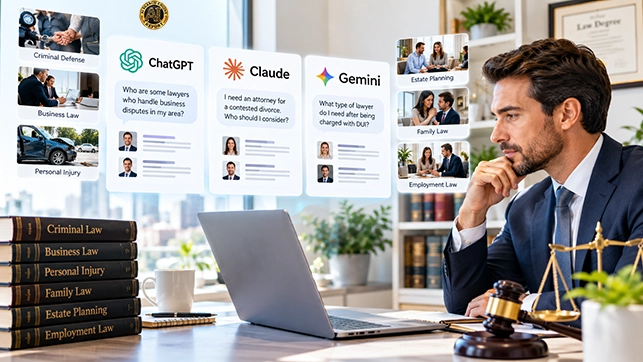
AI Search Engine Report for Lawyers
| How I Score Your Business in my AI Search Engine Report | |
| Does AI understand what your business is? | 20 Points |
| Does AI understand what you actually sell or provide? | 20 Points |
| Does AI understand who your business is for? | 15 Points |
| Does AI understand what makes your business different? | 15 Points |
| Does AI know when your business belongs in the conversation? | 15 Points |
| What does AI have wrong, missing, or confused? | 10 Points |
| Do ChatGPT, Claude, and Gemini understand your business the same way? | 5 Points |
| Total points available 100 points | |
Someone asking an artificial intelligence search engine for a lawyer is rarely looking for just any lawyer.
They may need a criminal defense attorney after an arrest. A business owner may need help with a contract dispute. Someone injured in an accident may be looking for a personal injury lawyer. A family may need an estate planning attorney. A company may need employment counsel.
That makes the way ChatGPT, Claude, and Gemini understand a lawyer particularly important.
The question is not simply whether an AI system recognizes the name of a lawyer or law firm. The real question is whether it understands what that lawyer does, which clients the lawyer represents, what kinds of matters the lawyer handles, and where those services are available.
My AI Search Engine Report manually examines those questions across ChatGPT, Claude, and Gemini.
What Does AI Understand About Your Law Practice?
A potential client may search Google for the name of a law firm. AI searches can be considerably more conversational.
Someone could ask:
“Who are some lawyers who handle business disputes in my area?”
“I need an attorney for a contested divorce. Who should I consider?”
“What type of lawyer do I need after being charged with DUI?”
“Which local attorneys handle estate planning for business owners?”
“Tell me about this law firm and what they specialize in.”
Those questions require AI to interpret far more than a business name.
The system has to connect a legal problem with an appropriate practice area and potentially connect that practice area with particular lawyers or firms.
Research published by the American Bar Association in 2026 found that consumers are already using AI tools and chatbots to research legal issues, although direct use of AI specifically to find a lawyer remains much smaller. That distinction matters. A potential client does not have to begin by asking AI for a lawyer. The recommendation opportunity can arise during the conversation about the underlying legal problem.
AI Search Engine Report for Lawyers
Law is an unusually classification dependent profession.
A lawyer can be highly qualified while still being completely inappropriate for a particular matter.
A criminal defense lawyer is not interchangeable with an estate planning lawyer. A personal injury attorney may represent plaintiffs rather than insurance companies. A business litigation practice may be substantially different from a firm focused on business formation and transactional work.
Location introduces another layer because legal practice is jurisdiction dependent.
The American Bar Association advises people choosing lawyers to consider areas of expertise, previous experience and the kinds of cases a lawyer generally handles. Jurisdiction also matters because lawyers are admitted to practice in particular jurisdictions and multijurisdictional practice involves its own professional rules.
An AI system therefore needs to understand several things simultaneously before its description or recommendation of a lawyer becomes useful.
How I Score a Lawyer’s AI Search Performance in My AI Search Engine Report
Does AI Understand What Kind of Lawyer You Are?
This is one of the first things I would want to examine for a law practice.
A firm’s website may contain dozens or hundreds of pages discussing attorneys, cases, industries, legal issues and practice areas. Other information about the firm may exist in bar profiles, legal directories, news coverage, professional biographies and other sources.
The resulting AI interpretation may be accurate.
It may also be incomplete.
A firm with several practice areas might be strongly associated with one while other significant areas receive little recognition. A lawyer who changed practice focus may still be associated with older work. A firm representing both individuals and businesses may be interpreted primarily as serving one group.
There are also meaningful distinctions within apparently similar practice areas.
“Business lawyer” could describe someone focused on formation, contracts, transactions, regulatory matters, intellectual property, employment issues or litigation.
“Family lawyer” could encompass divorce, custody, support, adoption and other matters.
“Criminal defense lawyer” can involve everything from misdemeanors and DUI cases to serious felony defense.
Simply getting the broad legal category correct is not necessarily enough.
Does AI Understand Who You Represent?
Practice area and client type are different questions.
Consider two employment law firms.
One primarily represents employers.
The other primarily represents employees.
Both legitimately belong to employment law, but confusing their client orientation could make an AI recommendation useless.
Similar distinctions appear throughout legal practice.
A bankruptcy attorney may concentrate on consumers or businesses. An insurance lawyer may represent insurers or policyholders. A personal injury firm may primarily represent injured plaintiffs. A real estate attorney might concentrate on commercial transactions rather than residential matters.
An AI system that understands the legal subject but misunderstands the client can still misunderstand the practice.
That is precisely the kind of distinction an AI Search Engine Report should uncover.
Geography Means More Than Finding the Nearest Office
Location matters differently for lawyers than it does for many local businesses.
A restaurant recommendation can largely be reduced to whether someone can reasonably travel there. Legal services can involve licensure, jurisdictions, courts and the location of the underlying matter.
A firm may have attorneys licensed in several states. Another may concentrate heavily on one jurisdiction. A lawyer might handle federal matters extending beyond the immediate city where the office is located.
This creates an important question:
What geographic practice does AI think the firm actually has?
ChatGPT could interpret that differently from Gemini. Claude could associate the firm primarily with its physical office location even when its actual practice extends further.
For a lawyer, geographic misunderstanding can change whether the firm appears relevant to a potential client’s question.
Individual Lawyer Versus Law Firm Understanding
Legal services introduce another distinction that many businesses do not have: the reputation and expertise of an individual professional can matter separately from the organization.
Someone may ask AI about the firm.
Someone else may ask about a particular partner.
Another person may ask for lawyers experienced with a specific type of matter.
The American Bar Association has specifically noted in guidance about selecting local counsel that the individual lawyer can be more important than simply selecting a law firm.
That raises useful diagnostic questions.
Does AI understand the firm but know very little about its attorneys?
Does it associate a particular attorney with the correct practice area?
Does it attribute one lawyer’s experience to the entire firm?
Does it recognize distinctions among lawyers within a multidisciplinary practice?
A firm level description can look perfectly reasonable while concealing substantial gaps in how AI understands the people actually providing the legal services.
What Happens When ChatGPT, Claude, and Gemini Disagree?
There is no single universal AI profile of a law firm.
ChatGPT may understand the firm’s primary practice correctly.
Claude may describe the firm more broadly.
Gemini may strongly associate it with one particular lawyer, location or area of law.
One system could recognize an important specialty that another barely acknowledges.
Those differences matter because potential clients are not all using the same system.
That is why I evaluate all three separately and then compare the findings.
The objective is not to ask one chatbot whether it “likes” a law firm. The objective is to determine what three major AI systems currently appear to understand about the practice and where those interpretations diverge.
Recommendation Visibility Requires Context
Being known by an AI system and being appropriate for a recommendation are different things.
A law firm might be recognized accurately when someone asks about it by name but never appear when someone asks for lawyers fitting the firm’s actual practice.
The reverse can also happen. An AI system might associate a firm with a category but misunderstand an important qualification that determines whether the firm is appropriate.
For lawyers, recommendation visibility therefore has to be examined in context.
The useful question is not:
“Does ChatGPT know my law firm?”
It is closer to:
“Does ChatGPT understand my law firm well enough to recognize when it is relevant?”
That is a much higher standard.
What the AI Search Engine Report Can Show a Lawyer
I manually evaluate your law practice across ChatGPT, Claude, and Gemini and compare what the three systems understand.
The analysis can identify where the models agree, where they disagree, what they appear to misunderstand, important information they omit, attributes they associate with the practice, recognition patterns, and recommendation visibility.
I also look for interpretation drift, outdated or incorrect information, and other findings that deserve attention.
The completed report is a 10+ page PDF and includes an AI Business Understanding Score, strategic observations, and recommendations based on what I find.
The price is a one time $495 purchase.
This is diagnosis, not implementation.
I do not sell SEO, GEO, AEO, AI visibility optimization or an ongoing marketing retainer after the report. I analyze what the systems currently understand, explain what I found, and provide recommendations based on those findings.
Do You Know What AI Thinks Your Law Practice Does?
You probably know exactly what types of matters you want.
You know which clients are a good fit.
You know the jurisdictions you serve, the work your attorneys actually perform, and the distinctions that separate your practice from another firm down the street.
The unanswered question is whether ChatGPT, Claude, and Gemini know those things too.
You do not have to guess.
Order the AI Search Engine Report for $495 and find out what all three systems currently understand about your law practice.