
AI Search Engine Report for Acoustics Testing Laboratories or Services
| How I Score Acoustical System Engineering Design Services business in my AI Search Engine Report | |
| Does AI understand what your business is? | 20 Points |
| Does AI understand what you actually sell or provide? | 20 Points |
| Does AI understand who your business is for? | 15 Points |
| Does AI understand what makes your business different? | 15 Points |
| Does AI know when your business belongs in the conversation? | 15 Points |
| What does AI have wrong, missing, or confused? | 10 Points |
| Do ChatGPT, Claude, and Gemini understand your business the same way? | 5 Points |
| Total points available 100 points | |
An acoustics testing laboratory may have specialized measurement equipment, experienced technicians, and accreditation for specific testing methods. But do ChatGPT, Claude, and Gemini understand what your laboratory actually does?
When a manufacturer needs sound power testing, an architect needs airborne sound transmission measurements, or a building product supplier needs documented sound absorption results, the difference between testing capabilities matters.
The AI Search Engine Report examines how these three AI systems understand, describe, compare, and potentially recommend your acoustical testing business. It identifies what they recognize correctly, what they misunderstand, and which important capabilities they may overlook.
What Does AI Understand About Your Acoustics Testing Laboratory or Service?
Acoustical testing is not one uniform service. Laboratories specialize in different measurement methods, testing environments, products, and applications.
One laboratory might evaluate sound transmission through walls, doors, and windows. Another might measure machinery noise emissions. A third might conduct field measurements inside completed buildings.
These differences determine whether a laboratory is suitable for a customer’s project.
When someone asks an AI system to identify a laboratory capable of performing a specific acoustical test, does the system recognize your actual services? Or does it associate your business with the broader acoustics industry without understanding your technical capabilities?
An AI system might correctly identify your company as an acoustical testing laboratory while failing to recognize that it performs testing under a particular ASTM or ISO standard.
That incomplete understanding could matter to a customer who needs a specific test method rather than general acoustical expertise.
Why Different Acoustical Testing Services Cannot Be Treated as Interchangeable
A laboratory’s testing capabilities are among the most important details AI systems need to understand.
Consider several common testing categories.
Sound Absorption Testing
Sound absorption testing evaluates how materials absorb incident sound energy.
Manufacturers of acoustical ceiling panels, wall treatments, insulation, and other sound absorbing products may require testing under methods such as ASTM C423 or ISO 354.
These tests are different from measuring how effectively a wall or floor prevents sound from passing into another space.
A laboratory specializing in absorption measurements should not automatically be described as providing every type of sound isolation testing.
Airborne Sound Transmission Testing
Airborne sound transmission testing evaluates sound passing through building assemblies and other barriers.
ASTM E90 is associated with laboratory measurements of airborne sound transmission loss. ASTM E336 addresses field measurements of airborne sound insulation in buildings.
A company capable of conducting laboratory testing under ASTM E90 does not necessarily provide field testing under ASTM E336.
If an AI system confuses these services, it may recommend a laboratory for work outside its actual capabilities.
Impact Sound Transmission Testing
Impact sound testing addresses noise generated by physical impacts, such as footsteps transmitted through floor and ceiling assemblies.
ASTM E492 is an important laboratory test method in this area.
Impact sound transmission and airborne sound transmission are different acoustic problems. A laboratory’s ability to measure one does not establish its ability to measure the other.
Machinery and Equipment Noise Testing
Manufacturers may require testing to characterize noise emitted by machinery, appliances, HVAC equipment, or industrial products.
Sound power measurements are particularly important because sound power characterizes the acoustic energy emitted by a source, while measured sound pressure depends partly on the surrounding environment and measurement position.
ISO 3744:2025 specifies engineering methods for determining sound power levels using sound pressure measurements under defined environmental conditions.
A laboratory offering equipment noise testing needs AI systems to recognize the applicable methods and measurement capabilities, not merely associate the business with general noise measurement.
Why Laboratory Accreditation Matters to AI Recommendations
Accreditation can be an important factor when customers select an acoustical testing laboratory.
In the United States, the National Voluntary Laboratory Accreditation Program, administered by NIST, includes an Acoustical Testing Services program. Accreditation assessments incorporate ISO/IEC 17025 requirements and additional program specific criteria.
However, accreditation should not be treated as a blanket qualification for every acoustical measurement.
The scope of accreditation matters.
A laboratory may be accredited for particular test methods without being accredited for every procedure it offers. Customers may need to verify the specific methods, measurement ranges, and other limitations covered by the laboratory’s current scope.
This creates a meaningful question about AI understanding.
If your laboratory is accredited for specific methods, do ChatGPT, Claude, and Gemini recognize those qualifications accurately?
Could one model correctly identify your accreditation while another simply describe the business as a certified acoustical testing company without identifying what that certification covers?
The distinction matters when a prospective customer must select a laboratory meeting a project’s technical or contractual requirements.
Can AI Distinguish Laboratory Testing From Field Acoustical Services?
Some acoustical testing businesses operate controlled laboratory facilities. Others provide measurements at construction sites, commercial properties, industrial facilities, or occupied buildings. Some provide both.
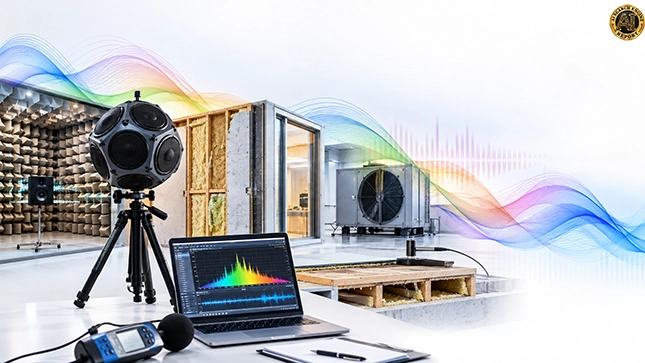
Controlled laboratory testing can involve reverberation rooms, transmission suites, anechoic chambers, or other specialized facilities.
Field services may include building sound insulation measurements, environmental noise surveys, equipment noise assessments, or verification of acoustic performance after installation.
These are not interchangeable service categories.
For example, an architect seeking laboratory sound transmission data for a wall assembly has a different requirement from a property manager investigating noise transmission in an occupied building.
An AI system that recommends the same company for both projects without understanding its services could produce an unsuitable recommendation.
Your AI Search Engine Report can examine whether the three models recognize the distinction between your laboratory facilities, field capabilities, and the actual services you provide.
AI Search Engine Report for Acoustics Testing Laboratories or Services
The AI Search Engine Report provides a manual diagnostic evaluation of how ChatGPT, Claude, and Gemini understand your acoustical testing business.
The analysis focuses on the business itself, not on whether your laboratory uses artificial intelligence in its testing procedures.
For an acoustical testing laboratory, the evaluation can reveal whether the models recognize the business as a specialized testing provider, understand its stated capabilities, associate it with appropriate customer requirements, and distinguish it from other acoustics related businesses.
The analysis also examines whether the models agree with one another.
A laboratory could be accurately identified by one AI system and misunderstood by another. The differences may involve technical specialties, available testing methods, customer applications, accreditation, or geographic service coverage.
Understanding those differences gives laboratory management a clearer picture of how the business is represented across major AI systems.
What Could Your Laboratory Learn From Comparing Three AI Systems?
Imagine a laboratory that provides sound absorption testing, airborne sound transmission testing, and specialized measurements for building product manufacturers.
ChatGPT might recognize its sound absorption capabilities but omit its transmission testing services.
Gemini might identify the laboratory’s broader range of services but associate it with a test method it does not perform.
Claude might accurately describe its technical specialization while failing to identify it when asked for a suitable testing provider.
These are hypothetical examples, not findings about any particular laboratory.
They illustrate why testing three systems individually can reveal more than checking whether a business name appears in a single AI response.
The analysis could also identify confusion between acoustical testing laboratories and other service providers.
An acoustical engineering consultant may design noise control solutions without operating a testing laboratory. A contractor may install soundproofing materials without conducting accredited laboratory measurements. An acoustical product manufacturer may maintain an internal testing facility without offering independent testing services to outside customers.
Environmental noise consultants may provide field assessments rather than controlled laboratory measurements.
These distinctions matter because the customer looking for a testing laboratory often has a defined technical requirement.
A business can be recognized by name while still being misunderstood in ways that affect its suitability for a particular recommendation.
Why Current Testing Capabilities and Standards Matter
Acoustical testing services evolve as laboratories expand their facilities, add measurement methods, update equipment, or change their accreditation scopes.
Technical standards also change.
For example, ISO 3744:2025 revised the earlier 2010 edition of the international standard for determining sound power levels using sound pressure measurements in an essentially free field over a reflecting plane.
For a laboratory performing equipment noise testing, accurate information about supported standards and testing methods is important.
A laboratory may publish current capabilities on its website, but that does not establish that every AI system understands or describes those capabilities correctly.
An AI model might reference an outdated service description, overlook an added testing method, or make assumptions based on the company’s name.
This raises another important distinction: a laboratory’s current accreditation scope and its general service descriptions are not necessarily identical.
A company might offer both accredited and nonaccredited testing services. A particular test may be available only at a designated facility. Some field measurements may require different equipment or procedures from the laboratory’s controlled testing methods.
If AI systems overlook these details, they may present an incomplete picture of the laboratory’s qualifications.
The AI Search Engine Report investigates what the models actually communicate about the business at the time of evaluation.
It does not assume that an updated website automatically produces updated AI answers.
What Is Included in the $495 AI Search Engine Report?
Frank Masotti personally conducts the analysis rather than relying on an automated scanner or an API driven testing script.
The $495 one time purchase includes a PDF report of more than 10 pages covering ChatGPT, Claude, and Gemini.
The report documents recognition patterns, business understanding, misunderstandings, omissions, associated attributes, recommendation visibility, and differences between the models.
It also includes strategic observations and recommendations based on the findings.
The completed report is delivered the next business day after analysis completion.
This is a diagnostic service. It does not include website optimization, changes to AI systems, implementation services, or guaranteed AI recommendations.
The purpose is to give you evidence about how major AI systems currently interpret your laboratory.
Does AI Understand Your Laboratory Well Enough to Recommend It for the Right Testing Work?
Your laboratory may have years of technical experience, specialized testing facilities, and clearly defined measurement capabilities.
The unanswered question is whether ChatGPT, Claude, and Gemini understand those capabilities accurately when someone researches acoustical testing services.
Do they recognize the test methods you perform? Can they distinguish your laboratory from acoustical consultants and installation contractors? Do they understand the customers and testing requirements your services are designed to support?
And when someone asks for a laboratory qualified to perform a specific test, do the AI systems recognize your company as a relevant option?
Without examining their responses, you do not know.
The AI Search Engine Report costs $495 as a one time purchase and provides a documented comparison of what all three systems understand about your business.
Order Your AI Search Engine Report and find out how ChatGPT, Claude, and Gemini actually interpret your acoustical testing laboratory.

About Frank Masotti
Frank Masotti personally conducts every AI Search Engine Report for Acoustics Testing Laboratories or Services.